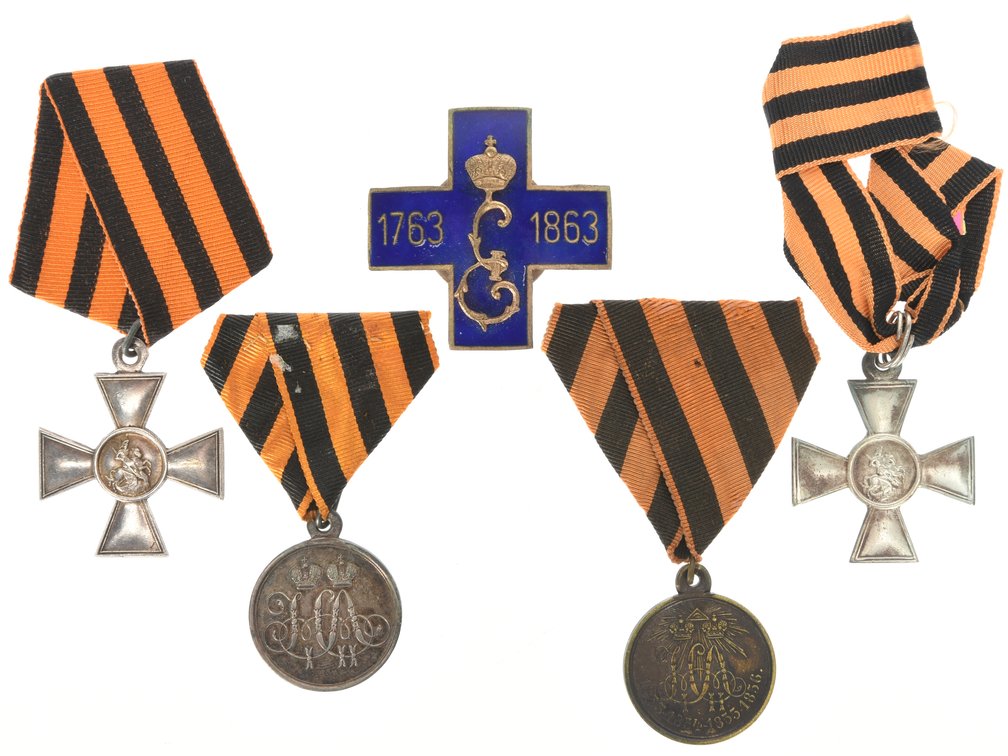
#297 • Imperial Russian Medals and Regimental Badge Lot
Part of British & World Medals (live auction by Bannerman Auctions)
High bid $550.00
Status: SOLD
Imperial Russian Medals and Regimental Badge Lot. Grouping of 4 Imperial Russian medals and 1-regimental badge including; 1.) Cross of St. George, 4th class with reverse number "386250". Medal exhibits some wear and tarnishing and displays proper ribbon on newer metal Russian mount. 2.) Cross of St. George, 4th class with reverse number "377348". Medal exhibits wear and tarnishing and displays proper ribbon. 3.) Bronze medal "In Memory of the Crimean War 1853-1854-1855-1856", awarded to soldiers and some civilians that participated in or supported the war. Medal exhibits even toning and displays proper ribbon. 4.) Silver medal for the Defence of Sevastopol 1854–1855 awarded to soldiers and sailors who defended the city during the Crimean War's Siege of Sevastopol. Medal exhibits some wear with tarnish and presents proper ribbon. 5.) Regimental enamel badge of the 34th Infantry Regiment of Sevsk. Badge is screwback and measures 45mm x 45mm and exhibits light wear. Reverse of badge is unmarked. Estimate: $300 - $600 Historical Background: The system of Imperial Russian medals and orders included some of the most prestigious awards in the world. Key honors included the Order of Saint Andrew the First-Called, the oldest and highest order, instituted in 1698 and typically bestowed upon royalty and heads of state, in addition to those recognized for great military accomplishments. Below it in rank was the Order of Saint George, which was established in 1769 as Imperial Russia's highest exclusively military award. Other significant orders included the Order of Saint Catherine (1714), the Order of Saint Alexander Nevsky (1725), the Order of Military Saint George (1769), and the Order of Saint Prince Vladimir (1782). Over time, more honors were established, such as the Order of the White Eagle and the Order of Saint Stanislaus, both instituted in 1831, and the Order of Saint Anna, which was established in 1797. The number of awards for these orders varied significantly; for instance, the Order of Saint Alexander Nevsky saw about 3,000 awards, while the Order of Saint Anna was awarded several hundred thousand times. These various orders and accompanying medals, including regimental badges, formed a complex structure of recognition for service to the Russian Empire, distinguishing accomplishments in military, civil, and charitable fields.