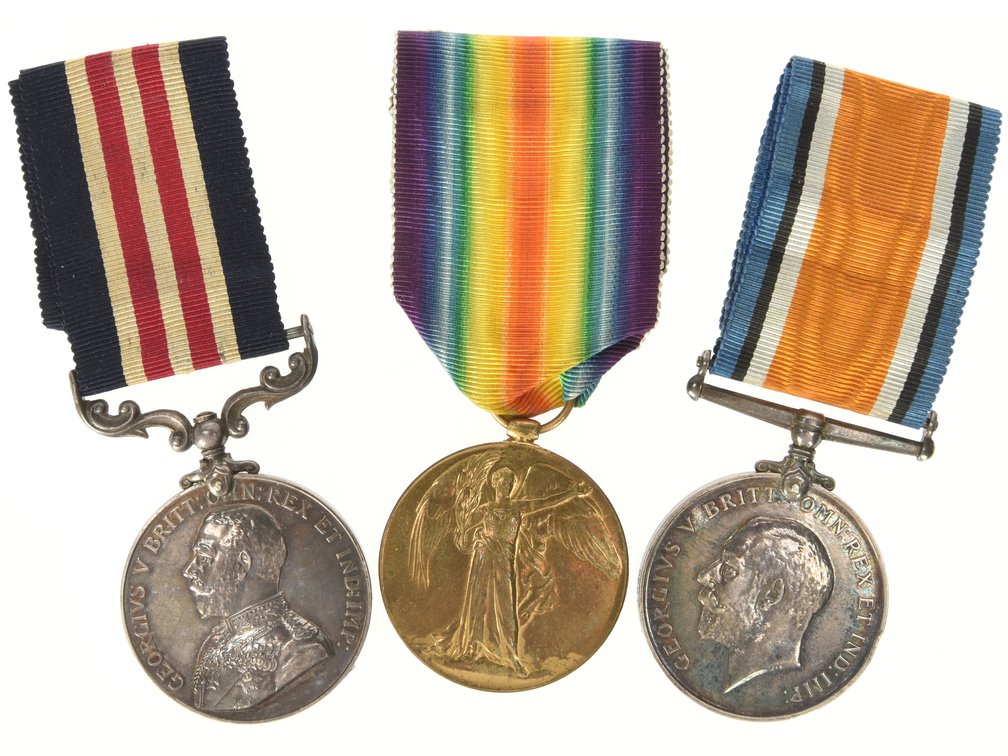
#213 • British World War I Medal Group incl. Military Medal (Bravery): Royal Inniskilling Fusiliers
Part of British & World Medals (live auction by Bannerman Auctions)
High bid $500.00
Status: SOLD
British World War I Medal Group incl. Military Medal: Royal Inniskilling Fusiliers. Grouping of 3 British World War I medals including; 1.) British World War I Military Medal (M.M.) . Medal is named (impressed) on rim "8781 SJT. F.P. BOND.1/ R.INNIS.FUS." in block capital letters. Medal exhibits even toning, some slight polishing wear, is in very fine conditions and presents proper ribbon. 2.) British 1914-1918 War Service Medal. Medal is named (impressed) on rim "8781 W.O. CL. 2. F. BOND. R.INNIS.FUS." in block capital letters. Medal exhibits even toning, some slight polishing wear, several edge knocks is in very good/fine conditions and presents proper ribbon. 3.) British World War I Victory Medal. Medal is named (impressed) on rim "8781 W.O. CL. II. F. BOND. R.INNIS.FUS." in block capital letters. Medal exhibits even toning, some slight polishing wear, several edge knocks is in very good/fine conditions and presents proper ribbon. Bond's Military Medal was Gazetted on November 11, 1916. Frederick Percy Bond, a Company Quartermaster Serjeant for the Royal Inniskilling Fusiliers died of wounds while a prisoner in France on May 20, 1917. He was awarded the Military Medal on November 11, 1916. He is buried in Cabaret-Rouge British Cemetery, Pas-de-Calais, France. Estimate: $400 - $600 Historical Background: The British World War I Medals for Bravery include several distinguished awards given for gallantry and service in the field. These decorations recognized the exceptional courage of soldiers and officers. Some of the major military awards for bravery included the Victoria Cross, the Distinguished Service Order, the Military Cross, the Distinguished Conduct Medal, and the Military Medal. Each award had specific criteria for recognition, with the Victoria Cross being the highest award for "other ranks." These bravery medals are distinct from the main campaign medals, which were issued for service. The campaign medals, such as the 1914 or 1914-15 Star, the British War Medal, and the Victory Medal, were often nicknamed "Pip, Squeak and Wilfred" when worn together. The bravery medals highlighted individual acts of heroism beyond the standard service requirement, recognizing the most distinguished acts of courage displayed by personnel during the war. The Royal Inniskilling Fusiliers raised a total of 13 battalions for service during the First World War, comprising 2 Regular, 9 Service, and 2 Reserve units. These battalions saw extensive action across multiple theaters of operation, including the major battles in France and Flanders, as well as significant campaigns in Gallipoli, Macedonia, and Palestine. The Regiment was greatly distinguished during these eventful years, being awarded eight Victoria Crosses. The 1st Battalion, starting in India, deployed to Gallipoli in April 1915 with the 29th Division, where it suffered heavy casualties before moving to France in March 1916. The 2nd Battalion was among the first British Expeditionary Force troops to land in France in August 1914, seeing early action at the Battle of Le Cateau. New Army battalions, including the 9th, 10th, and 11th, served on the Western Front with the 36th (Ulster) Division. The cost of the war was immense for the regiment, with a total of 5,938 men listed as First World War deaths.