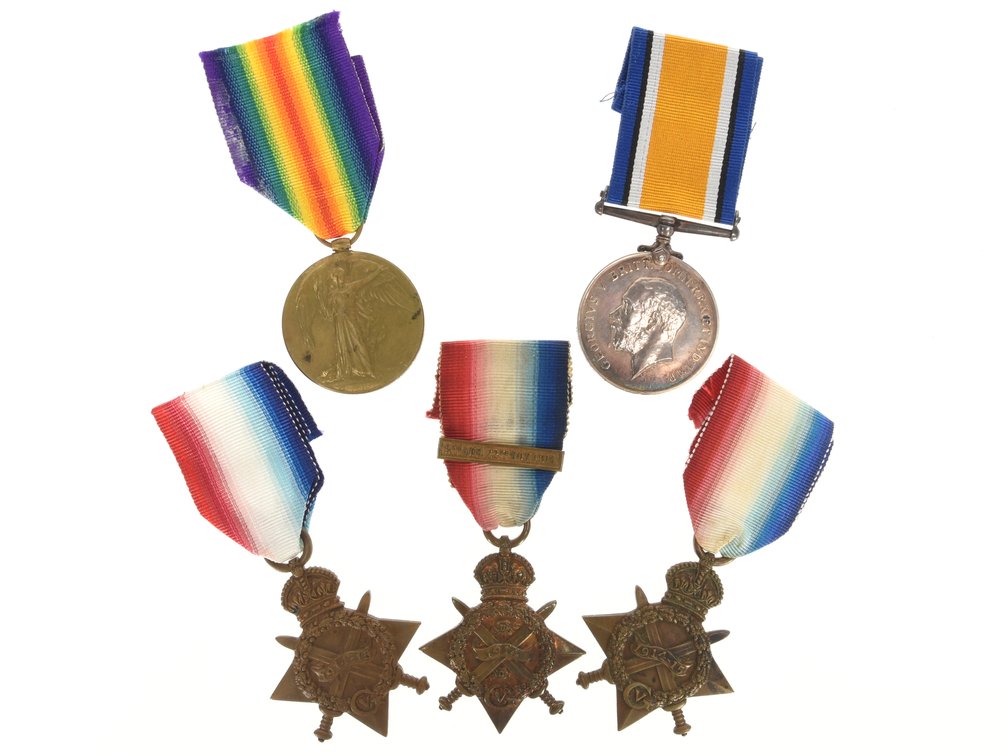
#214 • British World War I Medals - Royal Inniskilling Fusiliers and Durham Light Infantry
Part of British & World Medals (live auction by Bannerman Auctions)
High bid $120.00
Status: SOLD
British World War I Medals - Royal Inniskilling Fusiliers and Durham Light Infantry. Collection of 5 British World War I medals including: 1.) Aug/Nov 1914 Star medal with "5TH AUG.-22ND NOV 1914" bar. Medal is named (impressed) on reverse "8021 PTE A. DARRAGH. R.INNIS.FUS." Medal exhibits even toning and presents proper ribbon. 2.) 1914/1915 Star medal. Medal is named (impressed) on reverse "10129 PTE A. McNEILL. R.INNIS.FUS." Medal exhibits even toning with some spotting and presents proper ribbon. 3.) 1914/1915 Star medal. Medal is named (impressed) on reverse "10811 PTE J. McMANUS. R.INNIS.FUS." Medal exhibits even toning with some spotting and presents proper ribbon. 4.) A 1914-1918 War Service Medal. Medal is named (impressed) on rim "10965 PTE. H.J. SEDDON.DURH L.I." Medal exhibits even toning, some polishing wear, edge knocks and presents proper ribbon. 5.) A World War I Victory Medal. Medal is named (impressed) on rim "10811 PTE. J. McMANUS. R.INNIS.FUS." Medal exhibits even toning, some polishing wear, edge knocks and presents proper ribbon. Estimate: $100 - $200 Historical Background: The British World War I campaign medals were awarded to military personnel who served during the conflict. The three main medals often received together were the 1914 Star or 1914-15 Star, the British War Medal, and the Victory Medal. These three campaign medals were affectionately nicknamed "Pip, Squeak and Wilfred" by the servicemen. The 1914 Star was awarded to those who served in certain theaters of war between August 5 and November 22, 1914. The 1914-15 Star was for service between August 5, 1914 and December 31, 1915, who were not eligible for the 1914 Star. The British War Medal was issued to over six million individuals for service during the war, including to a large number of Commonwealth forces. It was sometimes paired with the Victory Medal and referred to as the "Mutt and Jeff" pair. The Allied Victory Medal was awarded to all those who received the 1914 Star or the 1914-15 Star, and to those who received the British War Medal. Another campaign medal was the Territorial Force War Medal, given to members of the Territorial Force who had volunteered for overseas service prior to September 30, 1914, and served abroad between August 4, 1914 and November 11, 1918. The Royal Inniskilling Fusiliers, an Irish line infantry regiment, greatly expanded during the First World War, ultimately raising 13 battalions. Its 2nd Battalion deployed to France with the British Expeditionary Force in August 1914, remaining on the Western Front throughout the war. The 1st Battalion returned from India in 1915 to participate in the Gallipoli campaign, including landings at Cape Helles, before transferring to the Western Front in 1916. The regiment's Service battalions also saw action in the Balkans, Palestine, and other fronts, with a composite battalion famously fighting during the Easter Rising in Dublin in 1916. The Durham Light Infantry was a light infantry regiment formed in 1881 that also saw extensive service during the Great War. It contributed numerous battalions, including several Territorial Force battalions, many of which were integrated into the 50th Northumbrian Division on the Western Front. For example, the 151st Brigade of the 50th Division included battalions from the DLI alongside the 6th Battalion of the Royal Inniskilling Fusiliers at different points in the conflict. Both regiments bore the heavy cost of the war, with the Royal Inniskilling Fusiliers alone suffering nearly 6,000 fatalities.