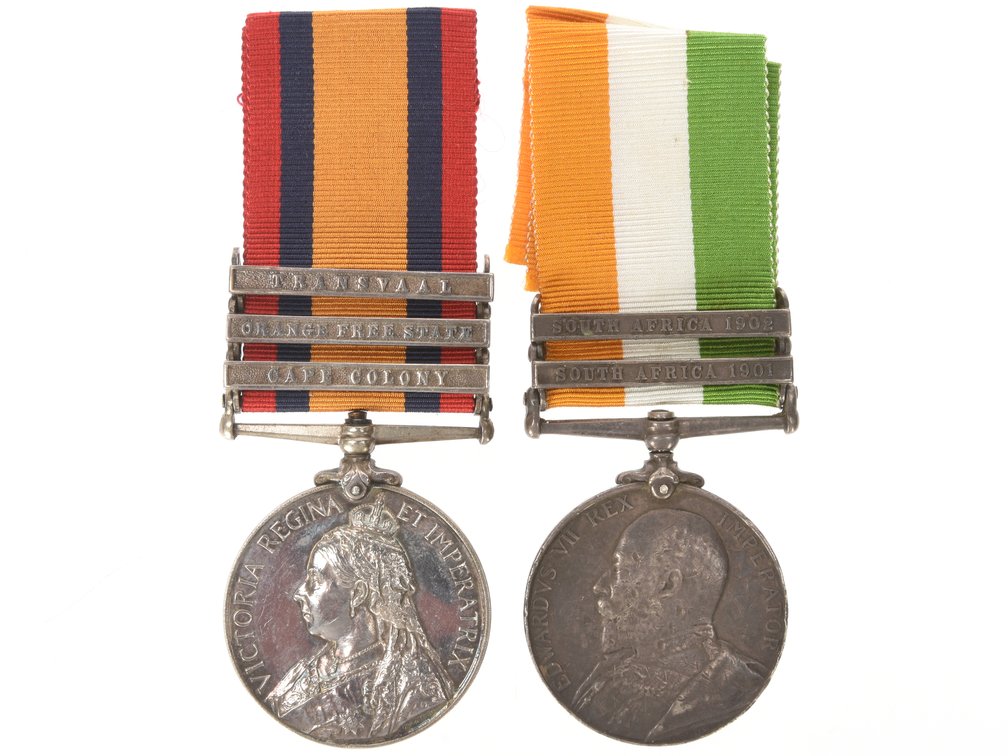
#186 • British Queen's South Africa and King's South Africa Medals - Royal Inniskilling Fusiliers
Part of British & World Medals (live auction by Bannerman Auctions)
High bid $140.00
Status: SOLD
British Queen's South Africa and King's South Africa Medals-Royal Inniskilling Fusiliers Pair of mismatched British Queen's South Africa and King's South Africa Medals including: 1.) British Queen's South Africa campaign medal with 3 campaign bars/clasps being "TRANSVAAL", "ORANGE FREE STATE" and "CAPE COLONY". Medal named (IMPRESSED) on rim "6497 PTE E. MCKERR. RL. INNIS. FUS." in block capital letters. Medal exhibits even toning, some surface abrasions, polishing wear and is in fine condition. Medal presents proper ribbon. 2.) British King's South Africa campaign medal with 2 campaign bars/clasps being "SOUTH AFRICA 1901" and "SOUTH AFRICA 1902". Medal named (impressed) on rim "6620 PTE. W. KEENAN. R. INNIS. FUS." in block capital letters. Medal exhibits even toning, some surface abrasions, some small edge knocks, polishing wear and is in fine condition. Medal presents proper ribbon. Estimate: $200 - $350 Historical Background: The Queen's South Africa Medal (QSA) and the King's South Africa Medal (KSA) were two distinct campaign medals awarded to British and Colonial forces for service during the Second Boer War. The QSA was authorized in 1900 and awarded to those who served in South Africa between October 11, 1899, and May 31, 1902. It is a silver or bronze circular medal featuring a crowned and veiled effigy of Queen Victoria on the obverse. The reverse shows Britannia holding a flag and a laurel wreath, with advancing soldiers and warships in the background. The QSA could be issued with up to twenty-six clasps, indicating participation in specific actions and campaigns. The King's South Africa Medal (KSA) was established in 1902 and was never awarded singly, always being paired with the QSA. Recipients had to have served between January 1, 1902, and May 31, 1902, and completed 18 months of service in the conflict prior to June 1, 1902. The KSA is a silver disk with King Edward VII in Field Marshal's uniform on the obverse, and the reverse is identical to the third version of the QSA reverse. It was awarded with two clasps: "SOUTH AFRICA 1901" and "SOUTH AFRICA 1902," although nurses who qualified for the medal did not receive the clasps. The Royal Inniskilling Fusiliers were heavily involved in the Second Boer War (1899-1902) in South Africa. The 1st Battalion arrived in Durban in late 1899, where it fought in the disastrous Battle of Colenso. Despite sustaining significant losses during this battle, the 1st Battalion played a crucial role in the successful advance to relieve Ladysmith, earning distinction for a courageous assault on a position later named Inniskilling Hill. This battalion remained on active service in the region until early 1903. The 2nd Battalion of the Royal Inniskilling Fusiliers arrived in South Africa later in the conflict, in early 1902, after serving in India. During the final stages of the war, the 2nd Battalion was primarily employed in anti-guerrilla operations. Its duties included guarding supply trains and manning the blockhouses established by the British forces to restrict the movement of Boer commandos. The regiment's historical ties to the area also include the service of its antecedent, the 27th Regiment of Foot, in earlier South African campaigns, such as the Eastern Cape frontier campaign in 1835 and operations near Durban in 1842.