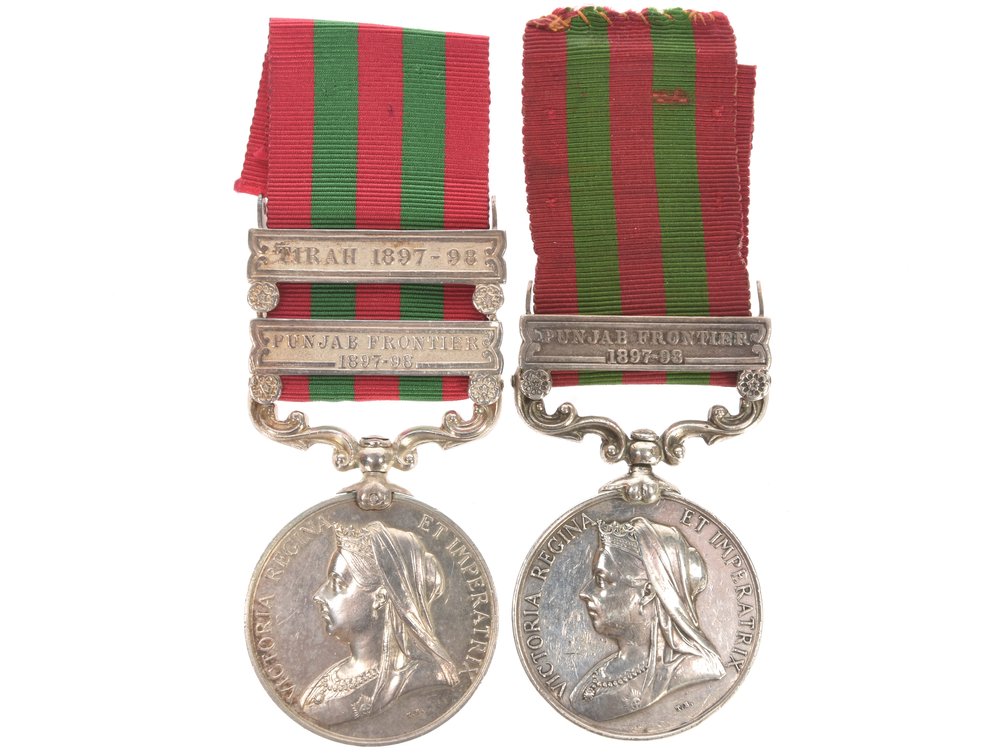
#185 • British India General Service Medals (1895-1902) - Royal Inniskilling Fusiliers
Part of British & World Medals (live auction by Bannerman Auctions)
High bid $225.00
Status: SOLD
British India General Service Medals (1895-1902) - Royal Inniskilling Fusiliers Pair of British India General Service Medals (1895-1902) including: 1.) British India General Service (1895-1902) campaign medal with 2 campaign bars/clasps being "TIRAH 1897-98" and "PUNJAB FRONTIER 1897-98". Medal named (engraved) on rim "3184 PTE. J. WYLIE 2ND BN RYL INNIS FUS" in script letters. Medal exhibits even toning, some surface abrasions, polishing wear and is in fine condition. Medal presents proper ribbon. 2.) British India General Service (1895-1902) campaign medal with 1 campaign bar/clasp being "PUNJAB FRONTIER 1897-98". Medal named (engraved) on rim "5031 PTE. J. COREY 2ND BN RYL INNIS FUS" in script letters. Medal exhibits even toning, some surface abrasions, some small edge knocks, polishing wear and is in fine condition. Medal presents proper ribbon. Estimate: $150 - $200 Historical Background: The India Medal was a campaign medal established in 1896 for issue to officers and men of the British and Indian armies, awarded for various minor military campaigns in India between 1895 and 1902. It chiefly recognized service on the North-West Frontier during this time and succeeded the India General Service Medal of 1854. The medal was presented by the United Kingdom of Great Britain and Ireland to British and Indian forces who participated in these campaigns. The medal itself was a silver or bronze disk, 36mm in diameter, with the name and details of the recipient typically engraved on the edge. The reverse, designed by G. W. de Saulles, featured a British and an Indian soldier together carrying a standard with the inscription "India 1895." Each specific campaign was denoted by a clasp attached to the ribbon; seven clasps were sanctioned, including Defence of Chitral 1895, Relief of Chitral 1895, and Tirah 1897–98. The ribbon was 32 mm wide and comprised five equal stripes of red, green, red, green, and red. The Royal Inniskilling Fusiliers had a deep and sustained connection to India, stemming from their formation in 1881 through the merger of the 27th Regiment of Foot and the 108th Regiment of Foot Madras Infantry, the latter becoming the 2nd Battalion. Prior to World War I, both regular battalions saw extensive garrison duty across the British Empire, including frequent postings to the Indian subcontinent. Notably, the 2nd Battalion was stationed in India and Burma from 1888 to 1899, participating in active combat during the Tirah Expedition of 1897 on the North West Frontier. When World War I began in August 1914, the 1st Battalion was stationed in Trimulgherry, Secunderabad, India. It was recalled to the UK in January 1915 and joined the 87th Brigade, a unit composed entirely of British battalions from the Indian Army establishment, before deploying to Gallipoli. The regiment continued its service in India during the interwar period, being posted to locations like Sialkot starting in late 1919. Furthermore, the 1st Battalion remained in the Far East during World War II, fighting in the Arakan in Burma before returning to India for internal security duties until 1947.