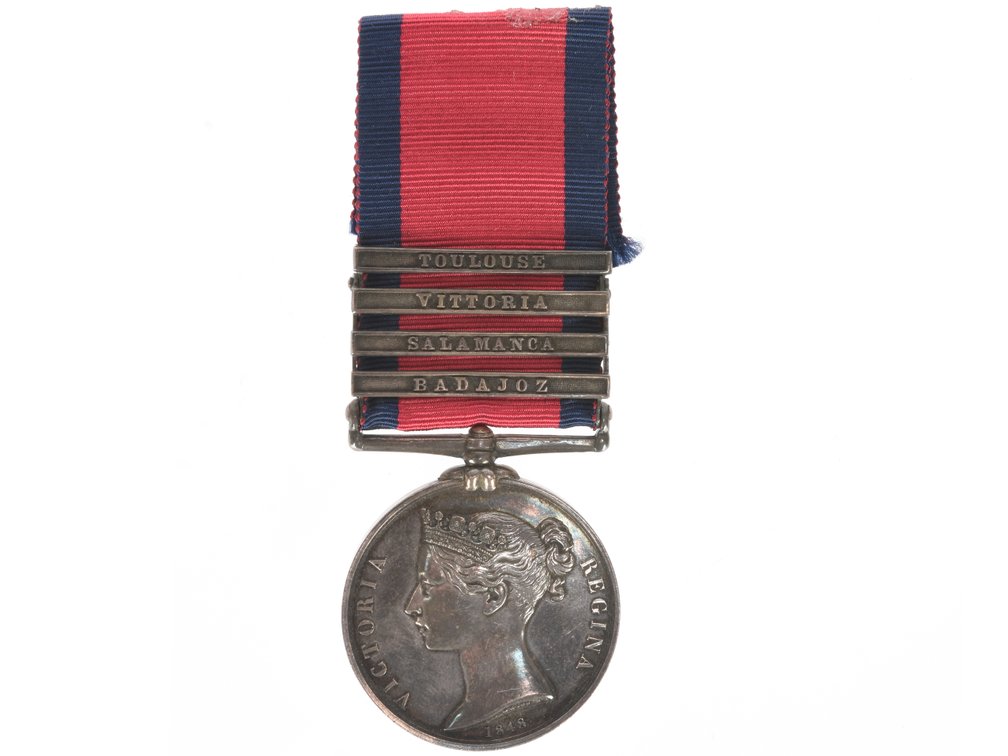
#135 • British Military General Service Medal (1793–1814): 27th (Inniskilling) Regiment of Foot
Part of British & World Medals (live auction by Bannerman Auctions)
High bid $2,500.00
Status: SOLD
British Military General Service Medal (1793–1814): 27th (Inniskilling) Regiment of Foot British Military General Service campaign medal with 4 bars/clasps being "TOULOUSE", "VITTORIA", "SALAMANCA" and "BADAJOZ". Medal named (impressed) on rim "WILLIAM GRAY, 27TH FOOT" in block capital letters. Medal exhibits even toning, minimal polishing wear and is in excellent condition. Medal presents proper ribbon. William Gray, a shoemaker by trade before he enlisted on October 13, 1807 at the age of 17. He served 27 years and 242 days before his discharge on December 6, 1832. William Gray is on medal rolls and entitled to all 4 bars that are present. He was wounded at Badajoz and also at Toulouse. He is listed as present at Plattsburgh. Estimate: $2000 - $4000 Historical Background: The Military General Service Medal (MGSM) was a campaign medal approved in 1847 and issued in 1848 to officers and men of the British Army who had participated in various military actions between 1793 and 1814. This period encompasses the French Revolutionary Wars, the Napoleonic Wars, and the Anglo-American War of 1812. The MGSM was a retrospective award, meaning it was issued many years after the campaigns occurred. It was designed by William Wyon, a silver disk 36 mm in diameter. The obverse features a left-facing effigy of Queen Victoria with the inscription "VICTORIA REGINA" and the date "1848," while the reverse depicts Queen Victoria crowning a kneeling Duke of Wellington with a laurel wreath. A total of 26,091 medals were issued. The MGSM was awarded with a variety of clasps, 29 of which were authorized, including those related to the Peninsular War and the War of 1812. The specific medal referenced, "British Military General Service Medal (1793–1814)-27th Regiment of Foot-Inniskillings," indicates the recipient served with the 27th Regiment of Foot, also known as the Inniskillings, during this period. Clasps were awarded for individual battles and campaigns, though none were authorized for service before 1801 or between 1802 and 1805. The maximum number of clasps awarded to a single recipient was 15. The medal's ribbon is 32mm wide, crimson edged with dark blue. The 27th (Inniskilling) Regiment of Foot was highly active during the Napoleonic Wars, a period during which it expanded to include 2nd and 3rd Battalions. This Irish regiment participated early on in the Egyptian Campaign, where a battalion fought at the Battle of Alexandria in 1801. Later, the 1st Battalion served in Italy and distinguished itself at the Battle of Maida in 1806. The various battalions were heavily involved throughout the Peninsular War in Spain and Portugal, participating in battles such as Busaco, Badajoz, Salamanca, Vitoria, and Toulouse. They were known for their bravery, such as the 2nd Battalion's stand at Castalla in 1813 where they inflicted severe casualties on French forces. The 1st Battalion was recalled from North America in 1815 to participate in the climactic Battle of Waterloo. As the only Irish infantry regiment present, the 1st Battalion held a crucial position in the center of the British line, forming a defensive square that endured prolonged French artillery fire and cavalry attacks. This action resulted in nearly 70 percent casualties, making it one of the most battered units of the day. The Duke of Wellington recognized their extraordinary courage, stating that it was "the regiment that saved the centre of my line." The unit continued its service, retaining its historic identity until the 1881 reforms, when it was merged to form The Royal Inniskilling Fusiliers.