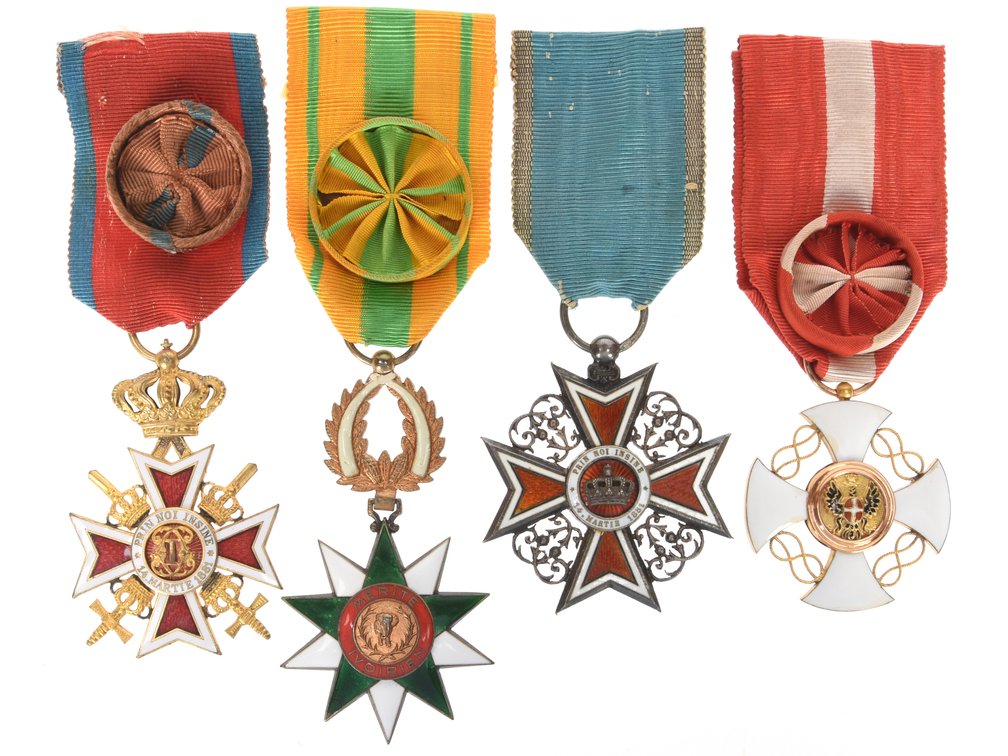
#315 • Group of Enameled Orders from Romania, Ivory Coast and Italy
Part of British & World Medals (live auction by Bannerman Auctions)
High bid $250.00
Status: SOLD
Group of Enameled Orders from Romania, Ivory Coast and Italy Grouping of 4 enameled Orders from Romania, the Ivory Coast and Italy including; 1.) Order Of The Crown Of Romania, 5th Class (Knight). Medal is a Type I (1881-1941). Medal in good condition with intact/fine enamel on obverse. Reverse of medal exhibits some enamel damage/loss in area around central medallion. Jump ring presents single hallmark. Medal presents correct ribbon (faded). 2.) Order of the Crown of Romania, 4th Class (Officer) with Swords. Medal is a Type II (1932- 1947 Issue). Enamel in several areas of central medallion on reverse exhibits some cracking/crazing to enamel. Medal presents correct ribbon (faded). 3.) Ivory Coast Order of Ivory Merit, 4th Class (Officer). Medal exhibits several cracks/chips to enamel (one on reverse with loss). Medal presents correct ribbon. 4.) Italian Order of the Crown, 4th Class (Officer). Medal exhibits some extremely small enamel cracks/crazes on reverse. Medal presents correct ribbon. Estimate: $300-450 Historical Background: This collection features a fascinating assortment of enameled orders, showcasing the distinctive heraldic and artistic traditions of three geographically and culturally diverse nations: Romania, Ivory Coast, and Italy. These decorations of honor typically represent military or civilian merit, often bestowed by the state, and are characterized by their intricate design, vibrant enameling, and use of precious metals. The juxtaposition of orders from Eastern Europe, West Africa, and Southern Europe offers a unique study in comparative vexillology and the varying standards of national recognition. The specific designs would reflect the respective national symbols and historical narratives. Romanian orders might display motifs associated with its monarchy or post-monarchical republic, while the Ivory Coast's honors would likely incorporate contemporary national emblems. Italian orders, with a history stretching back through its various states and the unified republic, would feature classic designs reflecting military valor or contributions to the arts and sciences. The presence of enamel work, a technique valued for its durability and color, highlights the permanence and prestige intended for these official tokens of achievement.