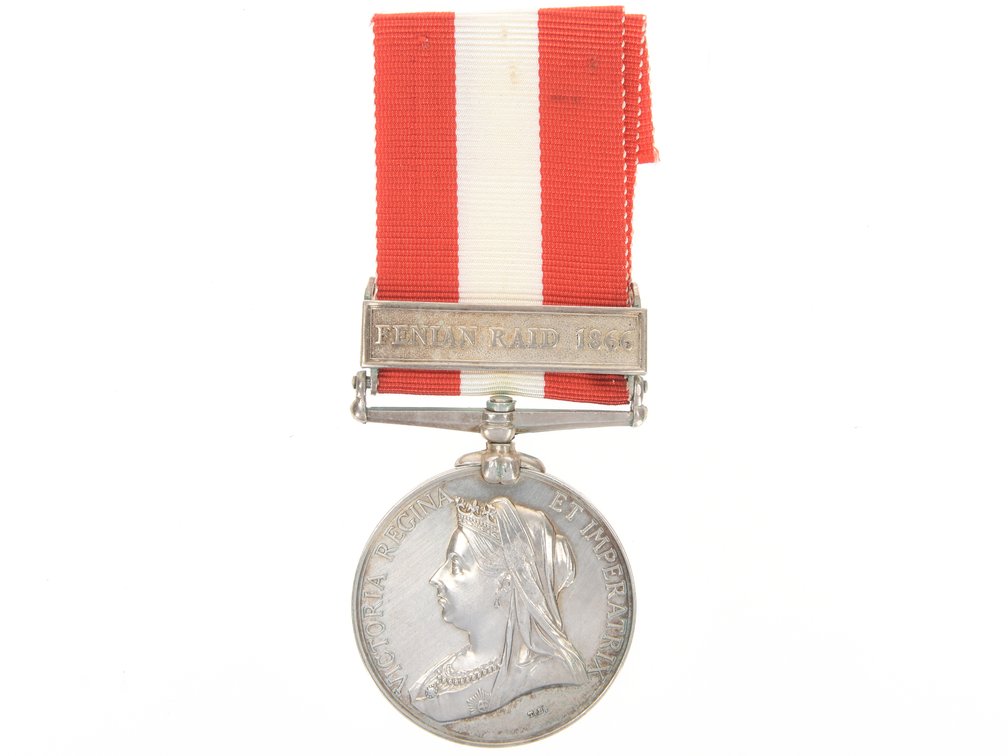
#163 • Canada General Service Medal (Fenian Raid) - Grimsby Cavalry
Part of British & World Medals (live auction by Bannerman Auctions)
High bid $375.00
Status: SOLD
Canada General Service Medal (Fenian Raid) - Grimsby Cavalry British Canadian General Service medal- with 1 clasp/bar being "FENIAN RAID-1866". Medal named (impressed) on rim "Tr. E. Ismond, Grimsby Cav." in block letters. Medal exhibits even toning, some light polishing wear, and is in extra fine condition. Medal presents proper ribbon. Enoch Ismond appears in the Canadian General Service medal rolls as serving as a trooper in the Grimsby Cavalry from the 1st thru 28th of June 1866 at St Catherines, Ontario and at sections along the Welland Canal. In the rolls he is listed as number 2601. Estimate: $500 - $700 Historical Background: The Canada General Service Medal (1866-1870) was awarded to members of the Imperial and Canadian forces who participated in the suppression of the Fenian raids in 1866 and 1870, as well as Riel's First Rebellion of 1870, also known as the Red River Expedition. The medal was established on January 1, 1899, long after the actions it commemorated. It was always awarded with a clasp, with the available clasps being "FENIAN RAID 1866," "FENIAN RAID 1870," and "RED RIVER 1870." A total of 17,623 medals were issued. This silver disk medal, 36 mm wide, was presented by both Canada and the United Kingdom of Great Britain and Ireland. The ribbon is 32mm wide and consists of three equal stripes of red, white, and red. The "FENIAN RAID 1866" clasp was specifically for services related to the Fenian raids of that year. Similarly, the "FENIAN RAID 1870" clasp recognized participation in the later raids. Only 12 medals were awarded with all three clasps. The Grimsby Cavalry took part in the defense of Canada during the Fenian Raids in the 1860s. These raids were carried out by Irish-American veterans of the Union Army, known as the Fenian Brotherhood, who sought to pressure Great Britain into granting Irish independence by attacking Canada. The cavalry unit, drawn from the Grimsby area of Upper Canada (now Ontario), was mobilized as part of the local militia forces called upon to guard the border and repel any incursions. Their service during this period is a notable element of Canadian military history, demonstrating the readiness of local defense forces. Their actions were primarily focused on surveillance and patrolling the Niagara frontier, a key area of concern for potential Fenian crossings from the United States. Although the Grimsby Cavalry may not have been involved in the major engagements, their presence and vigilance were vital in maintaining security and coordinating with other units. The participation of groups like the Grimsby Cavalry underscored the widespread community involvement in defending the Canadian colonies, leading up to the Confederation of Canada in 1867.