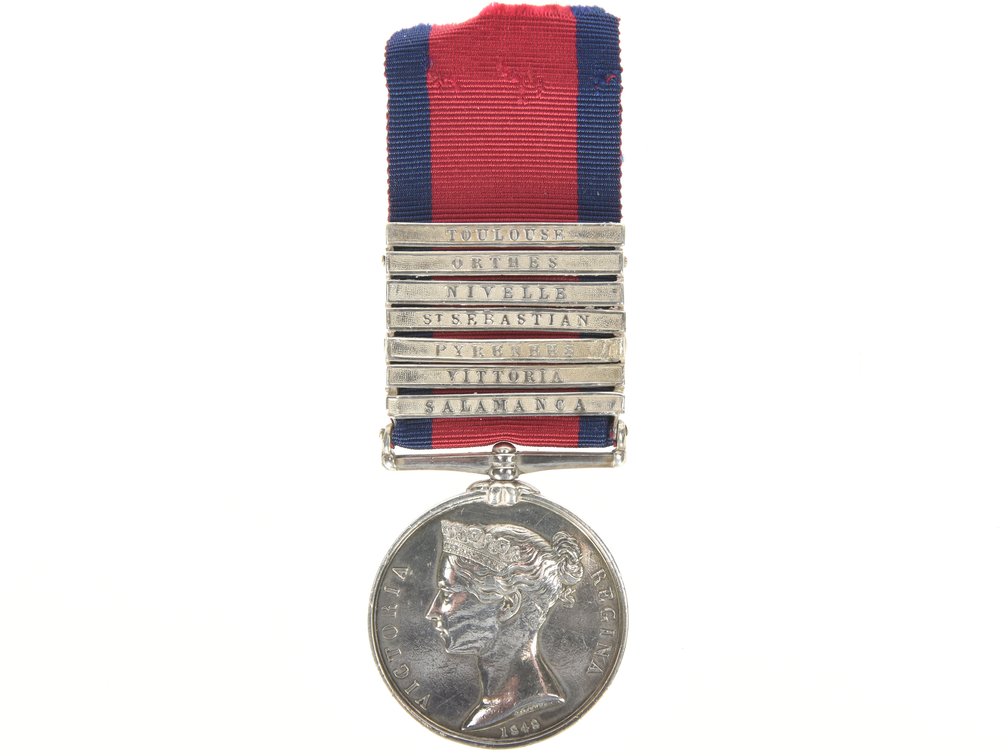
#137 • Military General Service Medal (1793-1814) with 7-bars: Royal Artillery
Part of British & World Medals (live auction by Bannerman Auctions)
High bid $1,300.00
Status: SOLD
Military General Service Medal (1793-1814) with 7-bars: Royal Artillery Great Britain Military General Service medal (1793-1814). Medal present 7-campaign bars being "TOULOUSE". "ORTHES", "NIVELLE", "ST. SEBASTIAN", "PYRENEES", "VITTORIA", and "SALAMANCA". Naming is officially impressed "J. HACKEN. ARTY DRIVER". Medal exhibits polishing wear, some edge knocks, some light surface scratches and is in fine condition. Medal shows proper ribbon. Hacken is present on rolls for MGS medal and is entitled to 7 bars. Estimate: $2000 - $3000 Historical Background: The Military General Service Medal (MGSM) was a campaign medal approved on June 1, 1847, and subsequently issued in 1848 to officers and men of the British Army. It served as a retrospective award for various military actions that occurred between 1793 and 1814, a period encompassing the French Revolutionary Wars, the Napoleonic Wars, and the Anglo-American War of 1812. The medal is made of silver and measures 36mm in diameter. Its obverse features a left facing effigy of Queen Victoria with the inscription "VICTORIA REGINA" and the date "1848." The reverse depicts Queen Victoria standing on a dais, crowning a kneeling Duke of Wellington with a laurel wreath. A total of 26,091 medals were issued to surviving veterans who had to apply and document their presence at the action. The specific medal mentioned is the Military General Service Medal with 7 bars and refers to service with the Royal Artillery. Clasps were authorized for specific battles and campaigns, although none were authorized for service before 1801 or between 1802 and 1805. There were 29 authorized clasps in total, with 21 related to the Peninsular War and three to the War of 1812. The presence of seven bars on a single medal indicates the recipient participated in seven different actions for which clasps were awarded. The distinction of "Royal Artillery" identifies the corps within the British Army to which the recipient belonged, a corps specializing in artillery duties. During the Napoleonic Wars, the Royal Artillery relied heavily on drivers to move its heavy guns, equipment, and ammunition across the battlefields and challenging terrain of Europe. These drivers were essential personnel, responsible for handling the horses that pulled the large artillery pieces. Their role demanded skill, physical endurance, and bravery, as they often operated under intense enemy fire while maneuvering their teams and equipment into firing positions or during retreats. The efficiency of the Royal Artillery on campaign was directly linked to the competence and dedication of these drivers. Artillery drivers were distinct from the gunners who operated the cannons; they generally wore specialized uniforms and were organized into troops or companies dedicated solely to logistics and movement. The work was arduous, involving long marches and the constant care of the horses, which were critical assets. Their service ensured that the British Army's powerful artillery arm could keep pace with the rest of the fighting force, providing necessary fire support and contributing significantly to the various victories achieved by Wellington and his forces throughout the long conflict.