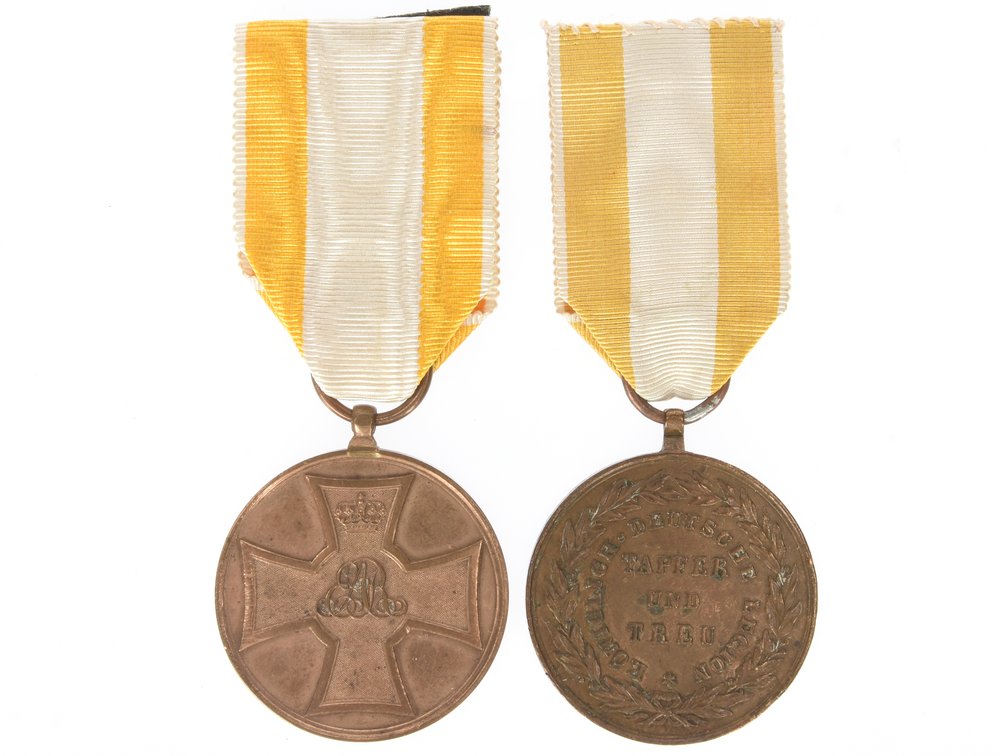
#90 • Hanoverian Medals to the Volunteers of the King’s German Legion: Napoleonic Campaigns
Part of British & World Medals (live auction by Bannerman Auctions)
High bid $300.00
Status: Sold
Hanoverian Medals to the Volunteers of the King’s German Legion: Napoleonic Campaigns. Pair of Hanoverian medals (35mm) to volunteers in the King's German Legion during the Napoleonic Wars. Both medals exhibit even toning, some light surface scratches/abrasions and are in fine condition. Both medal present proper ribbons. Awarded by King Ernst August of Hanover in 1841 to survivors of the Battle of Waterloo. Estimate: $200 - $300 Historical Background: The Hanoverian Medals to the Volunteers of the King’s German Legion recognized the service and gallantry of those who served in the King's German Legion (KGL) during the Napoleonic Wars. The KGL was a vital contingent of the British Army, composed mainly of Hanoverian troops who fled to Great Britain after the French occupation of Hanover. They distinguished themselves across various campaigns, including the Peninsular War and the pivotal Battle of Waterloo. One specific example is the Medal for Volunteers in the King's German Legion 1803-15, which was awarded by King Ernst August of Hanover in 1841 to survivors of the Battle of Waterloo. These medals served as a significant tribute to the loyalty and dedication of the KGL volunteers. Furthermore, the KGL was a major recipient of other honors, such as the Guelphic Medal, highlighting their considerable contributions and bravery in some of the era's most crucial engagements. The King's German Legion KGL was a highly respected formation of the British Army, created in 1803 following the French invasion and occupation of the Electorate of Hanover, which was a possession of the British crown. Formed primarily from veterans of the disbanded Hanoverian Army who escaped to England, the KGL quickly expanded from a single regiment to a mixed corps of all arms including light and heavy cavalry, infantry battalions, artillery, and engineers. It became known as one of the most effective and professional foreign forces serving under British command, and was the only German force that continuously fought against the French throughout the Napoleonic Wars from 1803 to 1816. The Legion initially established training centers and depots in England, notably at Bexhill for the infantry and Weymouth for the cavalry. The KGL played a crucial role in many major campaigns, including expeditions to Hanover, Copenhagen, and Walcheren, but gained its highest renown during the Peninsular War and at the Battle of Waterloo. Their cavalry, particularly the light dragoons, were considered elite and were arguably Wellington's best mounted troops. At Waterloo, the Second Light Battalion distinguished itself by heroically defending the strategically vital farm of La Haye Sainte against heavy French assaults. After Napoleon's final defeat, the KGL was disbanded in 1816, but its battle honors and traditions were incorporated into the newly revived Hanoverian Army, ensuring the unit's distinguished legacy continued into the future.