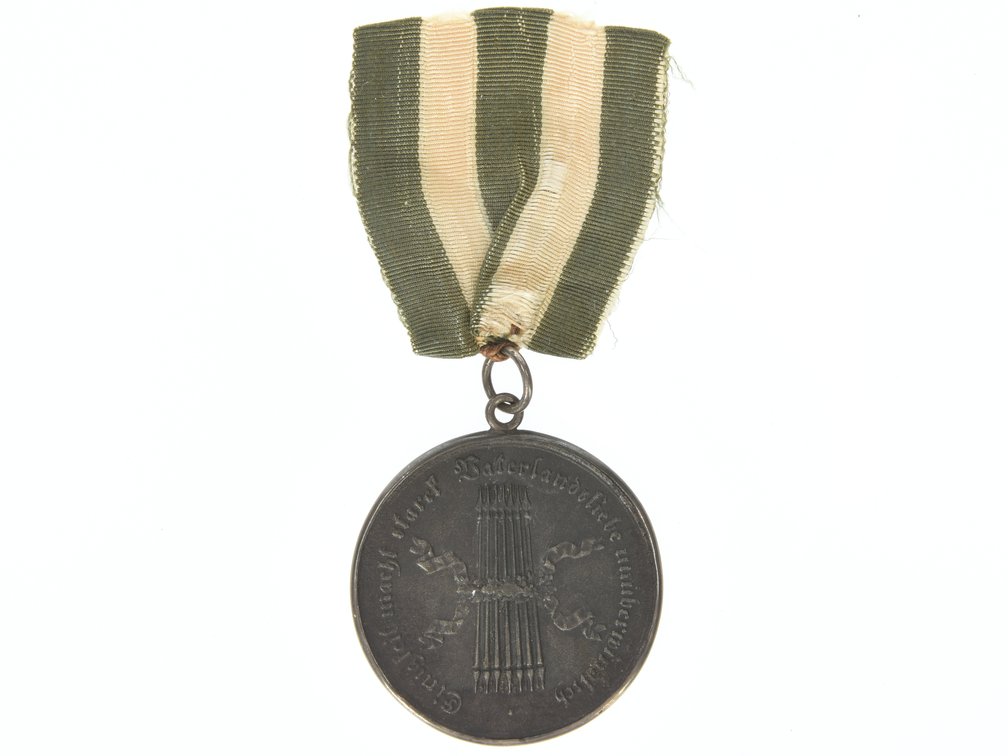
#74 • Duchy of Saxe-Coburg-Saalfeld Medal: Napoleonic Wars
Part of British & World Medals (live auction by Bannerman Auctions)
High bid $325.00
Status: Sold
Duchy of Saxe-Coburg-Saalfeld Medal: Napoleonic Wars. Saxe-Coburg-Saalfeld Medal (38mm) For Volunteers Of The German 5th Corps for 1814. Medal exhibits dark patina, some light wear and is in very good condition. Medal presents old ribbon. Estimate: $200 - $300 Historical Background: The Duchy of Saxe-Coburg-Saalfeld Medal, associated with the Napoleonic Wars, was issued around 1814. A specific example of such an award is the medal presented to Volunteers of the German 5th Corps. These medals honored those who defended the fatherland during the conflicts. The recipients were volunteer defenders who served in the Fifth German Army Corps, and the medal was often presented by their commander, General E. H. zu S. These medals served as a token of recognition and gratitude for the courage and valor demonstrated by the volunteers in the fight against French forces under Napoleon. They are historical artifacts, with known examples being round medals typically measuring around 38-39 mm in diameter, sometimes found with their original ribbons. The medal reflects the broader context of military decorations established by various German states during the period of the Napoleonic Wars, such as the famous Iron Cross established by Prussia in 1813. The German 5th Corps, as a formation within the larger Napoleonic Wars context, typically refers to units belonging to the Confederation of the Rhine or other German states aligned with or against Napoleon's French Empire. These corps were distinct from the main French army units and often comprised troops from kingdoms and principalities such as Bavaria, Saxony, or Württemberg. Their participation was critical in major campaigns, including the invasion of Russia in 1812 and the decisive battles fought across Central Europe in 1813 and 1814. Their effectiveness varied greatly depending on the loyalty of their state to France, the quality of their training, and the competence of their French or German commanders. These German units experienced the full spectrum of warfare during this era, suffering significant losses in engagements like the Battle of Leipzig. Following the collapse of French hegemony, many of these corps were reformed or switched allegiance to the coalition against Napoleon, contributing to the final victory in 1815. The complex history of these German corps highlights the fragmented political landscape of Germany at the time, where local loyalties and shifting alliances played a major role in the military conduct of the Napoleonic period.