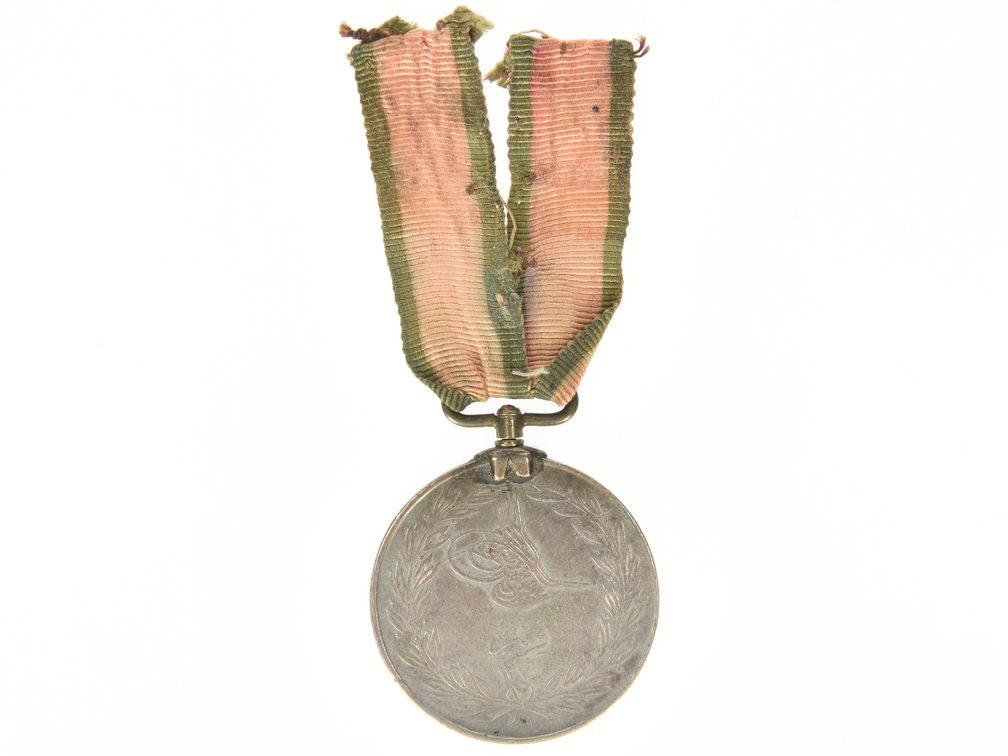
#304 • Turkish Crimean Medal: 13th Light Dragoons
Part of British & World Medals (live auction by Bannerman Auctions)
High bid $200.00
Status: SOLD
Turkish Crimean Medal: 13th Light Dragoons. Sardinian issue Turkish Crimean medal with "LA CRIMEA 1855" in exergue. Medal named (engraved) on rim "SERJEANT THOMAS DAVIES 13TH LIGHT DRAGOONS". Medal exhibits even toning, and polishing wear and is in very good condition. Medal presents proper ribbon (stained). This medal is named to Thomas Davies of the 13th Light Dragoons who was born at Berren near Newtown, Montgomeryshire, England in 1826. He enlisted at Worcester on October 14, 1850 at the age of 24. At the time of his enlistment, he was 5’ 7” and listed his occupation at Farrier. He was sent to Scutari, Turkey on October 19, 1854 and rejoined the regiment on December 14, 1854. He was promoted from Private to Corporal on January 2, 1856. Davies was then promoted to Sergeant on March 1, 1858. He reenlisted ay Aldershot, England for an additional 12 years on September 27. 1862. He was discharged from military service on June 24, 1873 at the age of 47 serving for 22 years and 235 days (2 years in Crimea/Turkey and 2 years 11 month in Canada). He died in 1873. The 13th Light Dragoons were part of the Charge of the Light Brigade, however Davis was sent to Scutari on October 19, 1854 and the “Charge” took place on October 25, 1854. The possibility that Davis took part in the charge is remote, however not totally impossible. As there is no complete roll of chargers from the charge of the light brigade we can only state that Seargent Davis was a member of the regiment in which numerous members made the charge. Records show that Davies was entitled to award of Crimean medal (one clasp-SEBASTOPOL), Turkish Crimean medal and Long Service and Good Conduct medal. Estimate: $400 - $600 Historical Background: The Turkish Crimea Medal was established in 1856 by Sultan Abdulmecid I of the Ottoman Empire to recognize the service of personnel from Great Britain, France, and Sardinia who participated in the Crimean War of 1853 to 1856. The medal is a silver disc, 36mm in diameter, with the Sultan's cypher on the reverse above Turkish Arabic script and the year 1271, which corresponds to 1855. The obverse features the word "CRIMEA 1855" in the exergue. The medal was designed by James Robertson and was issued in three distinct versions depending on the recipient's nationality. The medal was awarded to those who survived the war and was not given posthumously to next of kin. The fixed suspender on the British issue was similar to that of the British Crimea Medal. While original ribbons were narrow, typically 14mm wide, later ribbons were 32mm wide and primarily crimson in color with a narrow green stripe along each edge. Although some sources note original ribbon colors of red and black, the crimson and green ribbon became standard. No bars or clasps were authorized for this medal. The 13th Light Dragoons played a prominent role in the Crimean War (1854-1856) as part of the British Army's cavalry forces. The regiment, which was included in the Light Brigade commanded by Major General the Earl of Cardigan, saw action at the Battle of Alma in September 1854. They are most famously known for their participation in the Charge of the Light Brigade at the Battle of Balaclava in October 1854, where they formed the right flank of the first line of cavalry. During the controversial charge, the regiment drove through Russian artillery positions and smashed into the enemy's cavalry force, suffering heavy losses. Following the charge and the subsequent fighting, which included the Siege of Sevastopol throughout the winter of 1854, the regiment was eventually renamed. On April 8, 1861, the unit officially became known as the 13th Hussars, and they adopted hussar uniforms the following year.