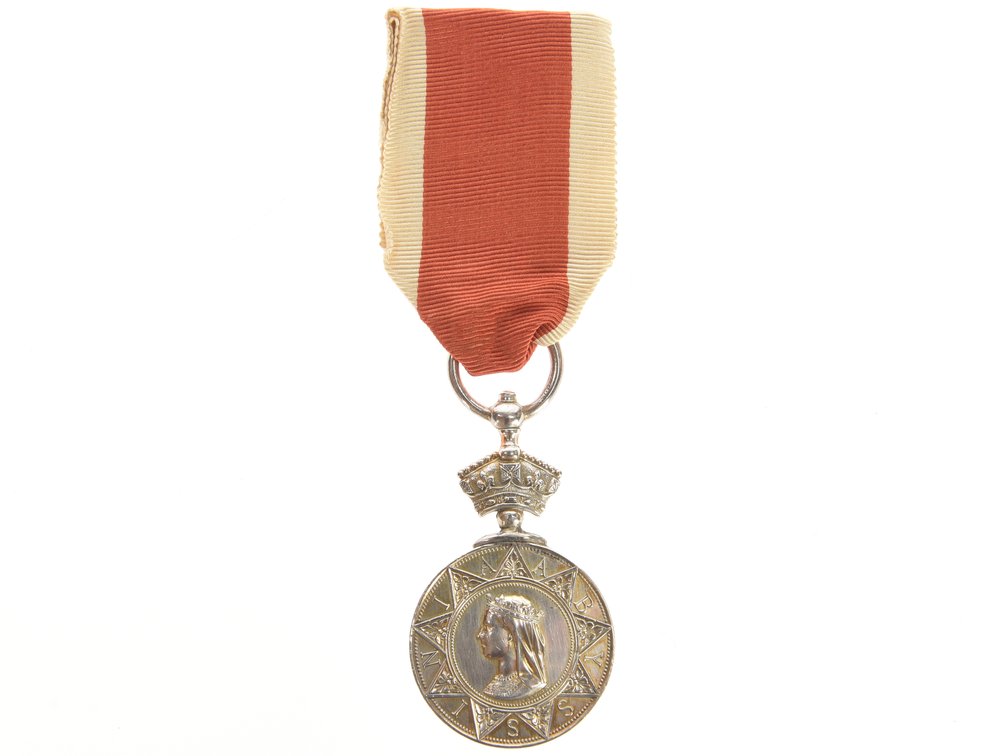
#165 • Abyssinian War Medal: Native Contingent
Part of British & World Medals (live auction by Bannerman Auctions)
High bid $150.00
Status: SOLD
Abyssinian War Medal: Native Contingent British Abyssinian War campaign medal. Medal named (impressed) on reverse "SOWAR SAKUR KHAN" in capital block letters. Medal exhibits even toning, some slight polishing wear, and is in very fine condition. Medal presents proper ribbon. Estimate: $300 - $400 Historical Background: The Abyssinian War Medal was a campaign medal established on 1 March 1869 by the United Kingdom. It was presented to soldiers and sailors of the British and Indian Army and Royal Navy who took part in the 1868 Expedition to Abyssinia. Approximately 14,000 medals were awarded, primarily to the British and Indian armies, with a smaller number given to the Royal Navy, including crews of ships on duty off the Ethiopian coast. Designed by Joseph and Alfred Wyon and struck at the Royal Mint, the medal is silver and measures 1.25 inches (32 mm) in diameter. The obverse features a small bust of Queen Victoria surrounded by a band of foliated triangles and the word "ABYSSINIA." The reverse is notable for having a blank central space for the recipient's name and unit, surrounded by a laurel wreath. It is suspended from a crown-attached ring and is borne upon a crimson ribbon with white borders. The Native Contingent for the 1868 Expedition to Abyssinia, officially known as the British Expedition to Abyssinia, was a crucial component of the force sent to rescue European captives held by Emperor Tewodros II. This contingent consisted primarily of soldiers and laborers recruited from India and other parts of the British Empire, reflecting the logistical necessity of utilizing locally available manpower and expertise for operations in challenging terrains and climates. Their roles went beyond combat, encompassing vital support services such as transport, engineering, and logistics, which were essential for maintaining the expeditionary force as it advanced through difficult mountainous territory toward Magdala. These locally recruited troops and support staff were indispensable to the mission's success, providing essential camel drivers, sappers, miners, and general laborers. Their familiarity with operating in similar environments, combined with their logistical skills, allowed the main British force to concentrate on its military objectives. Although often overlooked in historical narratives focusing on the main European combat units, the contributions of the Native Contingent were foundational to the swift and successful resolution of the campaign, culminating in the siege and capture of Magdala and the release of the prisoners.