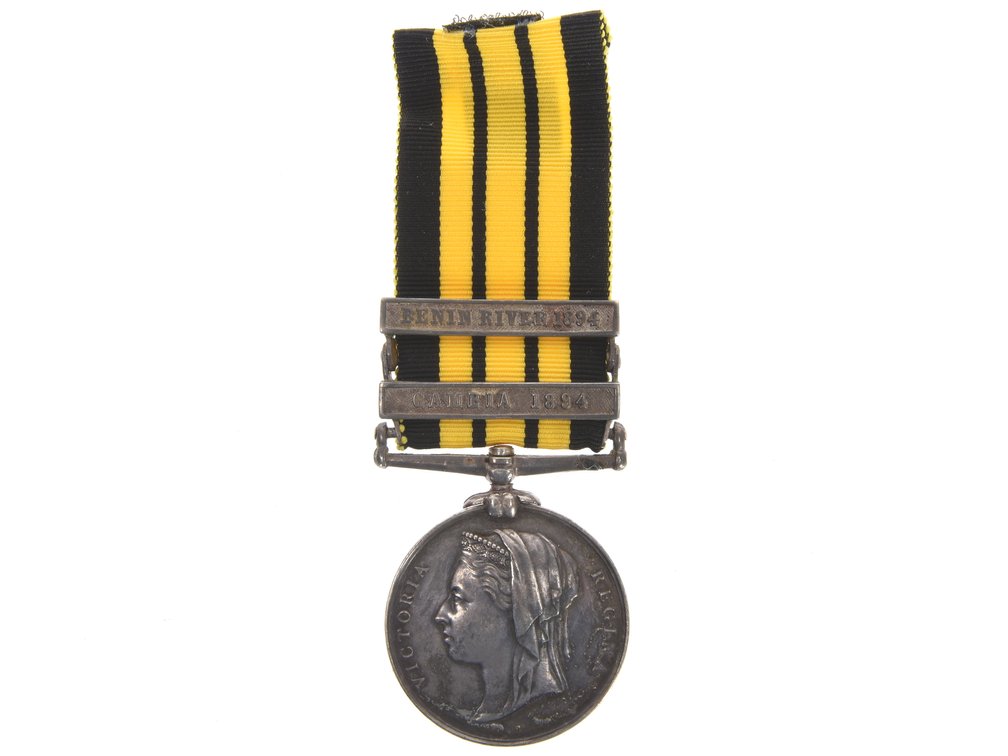
#166 • Ashantee Medal: HMS Alecto
Part of British & World Medals (live auction by Bannerman Auctions)
High bid $750.00
Status: SOLD
Ashantee Medal: HMS Alecto British Ashantee campaign medal- with 2 clasps/bars being "BENIN RIVER 1894" and "GAMBIA 1894". Medal named (impressed) on rim "C, JEFFERIES, E.R.A. H.M.S. ALECTO" in capital block letters. Medal exhibits toning with some spotting,, some slight polishing wear, some slight surface abrasions, and is in fine condition. Medal presents proper ribbon. Jefferies served as an Engine Room Artificer aboard the HMS Alecto. Estimate: $400 - $600 Historical Background: The Ashantee Medal was a British campaign award instituted on June 1, 1874, for forces involved in the Third Anglo-Ashanti War from June 1873 to February 1874. Struck in silver and measuring 36 millimeters in diameter, the medal features the diademed and veiled head of Queen Victoria with the inscription VICTORIA REGINA on the obverse. The reverse, designed by Sir Edward Poynter, displays a scene of bush fighting between British and Ashanti forces in a dense jungle setting. The ribbon is yellow with black edges and two narrow black central stripes, and the medal was awarded with the clasp COOMASSIE to those present at the battle of Amoaful and the capture of the Ashanti capital. The name "Ashanti Medal" also commonly refers to two later awards related to subsequent campaigns in the region. The Ashanti Star was established in 1896 for the Fourth Anglo-Ashanti War expedition against King Prempeh, presented as a bronze four pointed star with the date "1896" inscribed. Separately, the Ashanti Medal sanctioned in October 1901 was the first campaign medal authorized by King Edward VII, created for the troops engaged in the Third Ashanti Expedition or War of the Golden Stool in 1900. This 1901 medal featured King Edward VII on the obverse and a lion on the reverse, and was issued in silver to combatants and bronze to native carriers, often bearing the clasp KUMASSI. HMS Alecto (1882) was a composite paddle vessel and the third Royal Navy ship to bear the name Alecto, after a Greek mythological figure. Launched in 1882, this special service vessel was sold in 1899. Although the ship's launch date follows the conclusion of the major conflict, the name HMS Alecto was historically significant in naval innovation, particularly an earlier vessel of that name that participated in the famous 1845 experiment demonstrating the superiority of screw propulsion over paddle wheels. The Third Anglo-Ashanti War, which the cell associates with the vessel, occurred between 1873 and 1874 on the Gold Coast, ignited by disputes over the British acquisition of the port of Elmina and the refusal to pay tribute to the Ashanti king. The conflict saw British forces, commanded by General Sir Garnet Wolseley, defeat the Ashanti army, leading to the capture of the capital, Kumasi. The campaign concluded with a punitive peace treaty and the exile of the Ashanti king.