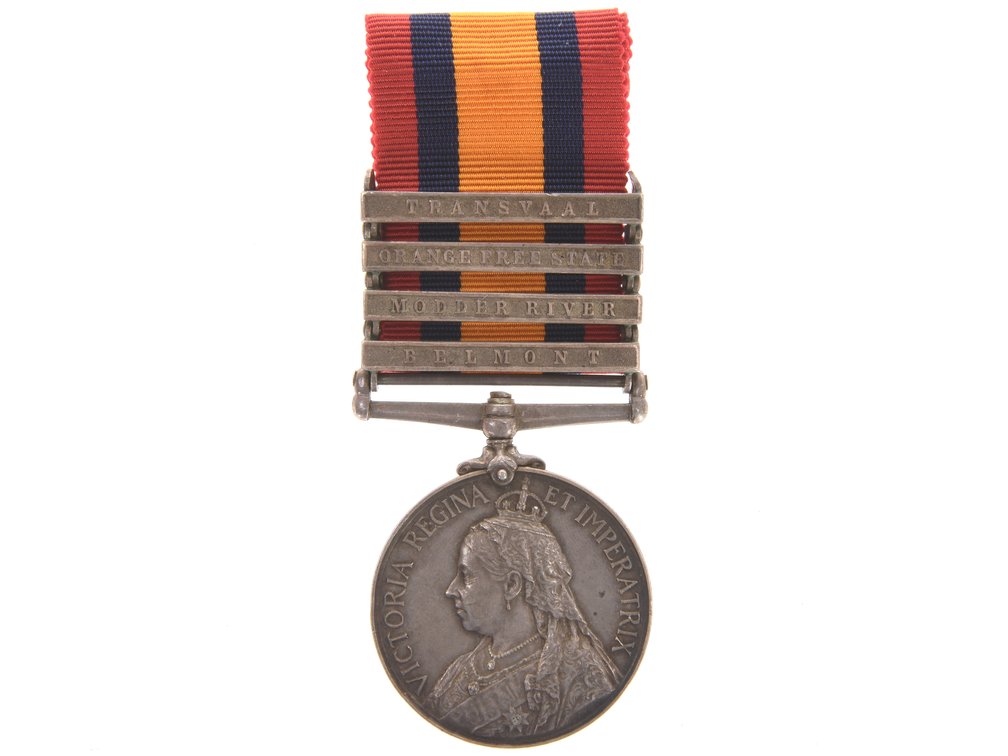
#196 • Queen's South Africa Medal: Loyal North Lancashire Regiment
Part of British & World Medals (live auction by Bannerman Auctions)
High bid $100.00
Status: SOLD
Queen's South Africa Medal: Loyal North Lancashire Regiment British Queen's South Africa Medal- with 4 clasps/bars being "BELMONT", "MODDER RIVER", "ORANGE FREE STATE", and "TRANSVAAL". Medal named (officially impressed) on rim "4270 PTE W. PICKUP, 1ST L.N. LANC: REGT" in capital block letters. Medal exhibits even toning, some polishing wear, surface abrasions, several edge knocks and is in very fine condition. Medal presents proper ribbon. Estimate: $200 - $400 Historical Background: The Queen's South Africa Medal is a British campaign medal established in 1900 and awarded to British and Colonial military personnel, as well as civilians serving in an official capacity, who participated in the Second Boer War in South Africa between October 11, 1899, and May 31, 1902. This silver and bronze circular medal features a crowned and veiled effigy of Queen Victoria on the obverse, with the legend "VICTORIA REGINA ET IMPERATRIX" around the upper perimeter. The reverse side depicts Britannia holding a flag in her left hand and extending a laurel wreath toward advancing soldiers, with two warships in the background. A total of twenty-six different clasps were awarded with the Queen's South Africa Medal, which were attached to the ribbon to signify participation in specific actions, campaigns, or defense periods during the war. These clasps are categorized into Battle, State, and Date groups. Examples of clasps include Cape Colony, Relief of Mafeking, Transvaal, and the date clasps South Africa 1901 and South Africa 1902. The first medals issued to Lord Strathcona's Horse included the dates 1899 and 1900 below the wreath on the reverse, but these dates were removed from subsequent medals as the conflict extended beyond 1900. The Loyal North Lancashire Regiment was formed in 1881 through the amalgamation of the 47th and 81st Regiments of Foot, establishing its depot at Fulwood Barracks in Preston. The regiment’s 1st Battalion saw extensive service in the Second Boer War (1899-1902). This included defending the diamond town of Kimberley during the four-month siege, where the unit, as the only regular infantry, formed the core of the garrison commanded by Lieutenant Colonel Robert Kekewich. They engaged in successful sorties at Dronfield and Modder River, where they famously crossed the river under fire to turn the Boer flank. Separately, the 3rd (Militia) Battalion mobilized and served overseas, garrisoning Malta until May 1901 and later receiving the Mediterranean Medal. During the First World War, the regiment expanded greatly, raising 15 new battalions which served across multiple theaters including the Western Front, Salonika, Palestine, and Mesopotamia. The 10th Battalion sustained heavy casualties while assaulting German positions during the Battle of Pozières in July 1916. In the Mesopotamian Campaign, Captain Oswald Reid, attached to the 6th Battalion, earned the Victoria Cross in March 1917 for holding a critical position for 30 hours against constant Turkish attacks during the successful push to capture Baghdad. Following the war, in 1921, the regiment was renamed The Loyal Regiment (North Lancashire).