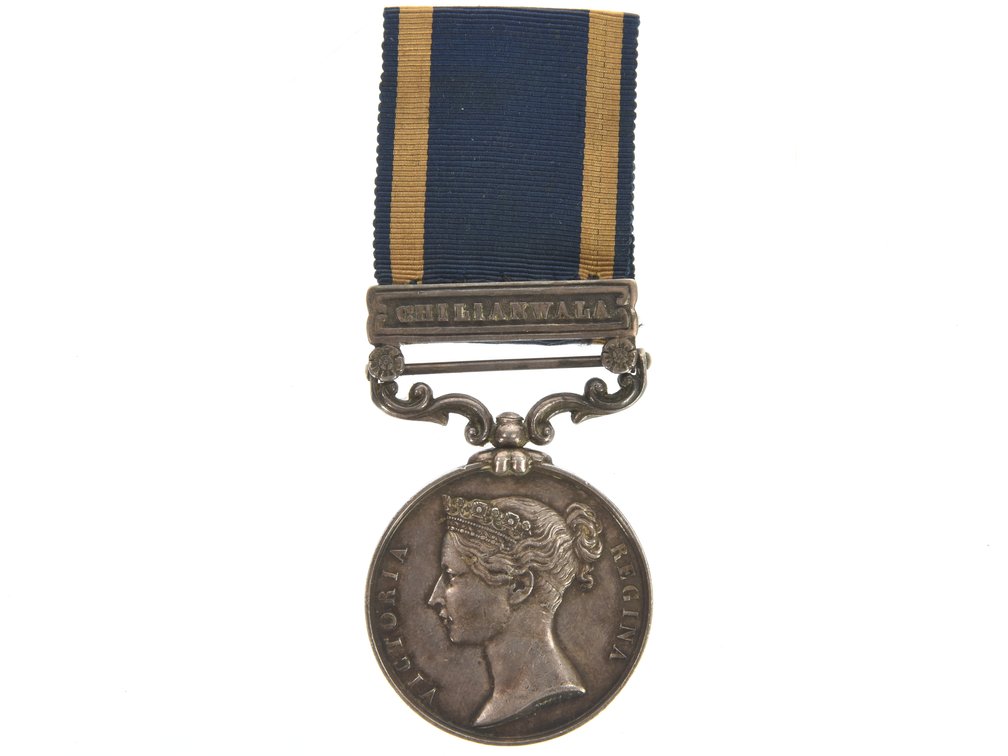
#151 • Punjab Medal-2nd European Regiment
Part of British & World Medals (live auction by Bannerman Auctions)
High bid $275.00
Status: SOLD
Punjab Medal-2nd European Regiment British Punjab campaign medal presenting campaign bar/clasp "CHILIANWALA". Medal named (officially impressed) on rim "G. BANKS, 2ND EUR. REGT" in capital block letters. Medal exhibits even dark toning, some polishing wear, surface abrasions/scratches, light edge knocks and is in fine condition. Medal presents proper ribbon. Estimate: $300 - $400 Historical Background: The Punjab Medal was a campaign medal established on April 2, 1849, for officers and men of the British Army and the Honourable East India Company. It was awarded for service in the Punjab campaign of 1848–49, which ultimately led to the British annexation of the Punjab. The medal is a 36-millimetre silver disk designed by William Wyon. The ribbon for the medal is 31.7 millimetres wide, dark blue with a yellow stripe toward each edge. The medals were impressed with the recipient's name and details in roman capitals. The medal's obverse features the diademed head of Queen Victoria with the legend VICTORIA REGINA. The reverse depicts Major-General Sir Walter Gilbert on horseback receiving the surrender of the Sikhs, with the inscription TO THE ARMY OF THE PUNJAB around the top circumference and the date MDCCCXLIX in the exergue. Clasps were issued for significant battles during the campaign, including Mooltan, Chilianwala, and Goojerat. The clasps read downward from the top of the medal, contrary to the usual practice of placing the earliest clasp nearest the medal. The Punjab campaign of 1848–1849 refers to the Second Anglo-Sikh War, a significant military conflict between the East India Company and the Sikh Empire. The war was triggered by widespread unrest and resentment following the First Sikh War and was officially ignited by a rebellion in Multan. On 18 April 1848, the murder of British officers Patrick Vans Agnew and Lieutenant William Anderson at Multan sparked the widespread rebellion, forcing Diwan Mulraj Chopra into open revolt and prompting large numbers of Sikh soldiers to join the uprising across the Punjab. The campaign involved several fierce battles, including the Siege of Multan, the Battle of Ramnagar, the indecisive Battle of Chillianwala, and the decisive Battle of Gujrat. Forces such as the 2nd European Regiment, identified as the 2nd European Light Infantry, participated in key engagements like Ramnagar as part of the Bengal Army contingent. The conflict ultimately ended in a decisive British victory, resulting in the annexation of the Punjab region by the East India Company, which completed its control over the Indian subcontinent.