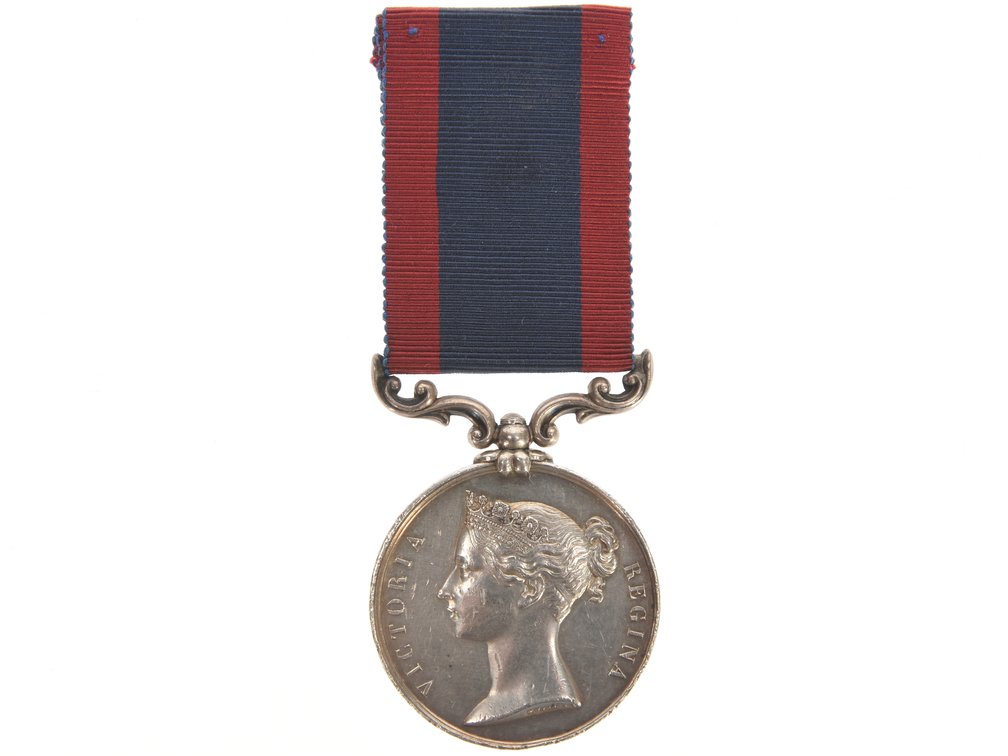
#150 • Sutlej Medal: 29th Regiment of Foot
Part of British & World Medals (live auction by Bannerman Auctions)
High bid $700.00
Status: SOLD
Sutlej Medal: 29th Regiment of Foot British Sutlej campaign medal exhibiting "FEROZESHAH, 1845" at bottom edge of reverse indicating medal recipient's first battle of this campaign. Medal named (officially impressed) on rim "CHARLES KERLE 29TH REGT" in capital block letters. Medal exhibits even dark toning, some polishing wear, surface abrasions, light edge knocks and is in very good condition. Medal presents proper ribbon. Estimate: $300 - $400 Historical Background: The Sutlej Medal is a campaign medal established on April 17, 1846, by the United Kingdom of Great Britain and Ireland for service during the First Anglo-Sikh War (Sutlej Campaign) of 1845–46. It was awarded to British and Honourable East India Company forces. This medal is historically significant as it was the first British medal to utilize clasps to denote soldiers who fought in the major battles of the campaign. The possible clasps were Ferozeshuhur, Aliwal, and Sobraon. The battle in which the recipient first participated, such as Mudki, would be engraved directly onto the medal, with subsequent battles added via clasps. The medal itself is a circular silver disk, 36 millimetres in diameter, designed by William Wyon. The obverse features the diademed head of Queen Victoria with the legend VICTORIA REGINA. The reverse displays a standing figure of Victory, facing left and holding a wreath in her outstretched hand, with a collection of trophies at her feet. The recipient's name and unit were impressed on the rim. The ribbon for the medal is 31.7 millimetres wide, dark blue with crimson edges. The 29th Regiment of Foot, formally the 29th Worcestershire Regiment of Foot, was a highly decorated unit founded in 1694. The regiment carried notable traditions, including having an English motto 'Firm' and using the elongated garter star on its badge. They earned the unique nickname 'The Ever Sworded 29th' after an incident in the 1740s mandated that all officers wear swords, even when off duty. After earlier service in conflicts like the Peninsular War, the 29th was transferred to Bengal in 1842, setting the stage for their involvement in the pivotal First Anglo-Sikh War, also known as the Sutlej Campaign, which erupted in December 1845. The Sutlej Campaign saw the 29th Regiment involved in bitter fighting against the formidable Sikh Khalsa Army. They famously marched 170 miles in nine days to reach the front lines near the Sutlej River. The regiment suffered heavy losses at the Battle of Ferozeshah in December 1845, where they lost 250 men out of 785 in the engagement. Their participation was also crucial at the final and decisive Battle of Sobraon in February 1846, where they helped break through the heavily fortified Sikh earthworks despite sustaining another 186 casualties. This British victory led to the end of the First Anglo-Sikh War, and the service members were recognized with the Sutlej Medal.