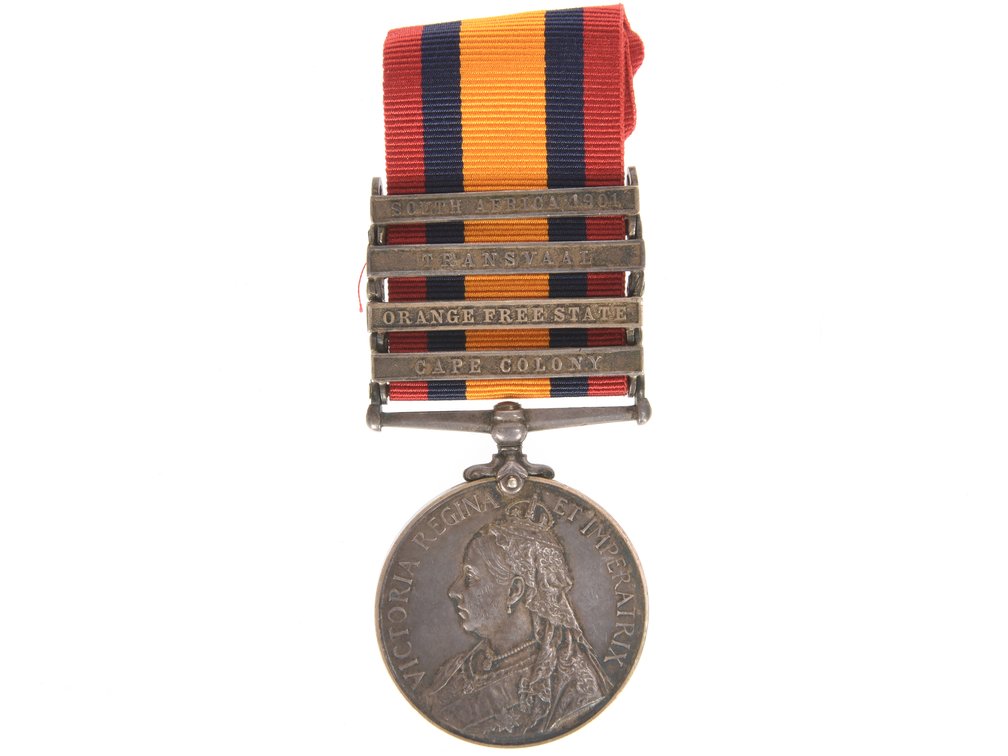
#199 • Queen's South Africa Medal-71st Company of Imperial Yeomanry
Part of British & World Medals (live auction by Bannerman Auctions)
Starting at $250.00
Status: PASS
Queen's South Africa Medal-71st Company of Imperial Yeomanry British Queen's South Africa Medal- with 4 clasps/bars being "CAPE COLONY", "ORANGE FREE STATE", "TRANSVAAL", and "SOUTH AFRICA 1901". Medal named (officially impressed) on rim "32940 PTE C. CARNELL. 71ST COY IMP: YEO:" in capital block letters. Medal exhibits even dark toning, some light polishing wear, surface abrasions and is in very fine condition. Medal presents proper ribbon. The 71st Company of Imperial Yeomanry was part of the 18th Battalion and designated as "Sharpshooters". The men of this unit were selected from volunteers who could prove their skill with a rifle and their horsemanship. The 18th Battalion comprised 67th, 71st and 75th (Sharpshooters) Companies recruited in London and 70th (Scottish or HQ) Company recruited in Scotland. Estimate: $500 - $800 Historical Background: The Queen's South Africa Medal is a circular, silver military campaign medal authorized in 1900 for service in the South African War, also known as the Second Boer War, between October 11, 1899, and May 31, 1902. It was awarded to all who served in South Africa during this period and was presented by the Monarch of the United Kingdom of Great Britain and Ireland to British and Colonial forces. The obverse of the medal features a crowned and veiled effigy of Queen Victoria, facing left, with the legend "VICTORIA REGINA ET IMPERATRIX" around the upper perimeter. The reverse depicts Britannia, facing right, holding a standard and extending a laurel wreath over a grouping of troops marching towards the coast and two men-of-war in the background. Around the top perimeter are the words "SOUTH AFRICA." Altogether, twenty-six clasps were awarded with the medal, indicating participation in specific actions and campaigns of the Second Boer War, falling into three groups: Battle, State, and Date clasps. Examples of clasps include Rhodesia, Relief of Mafeking, Defence of Ladysmith, and Paardeberg, among others. The ribbon is 1.25 inches wide, consisting of five stripes: red, dark blue, orange center, dark blue, and red. The first medals awarded bore the dates "1899" and "1900" on the reverse, but these dates were removed from subsequent issues as the war continued past 1900. Approximately 178,000 of these medals were total, with naming usually done in indented block or sloping capitals. The 71st Company of Imperial Yeomanry was a volunteer mounted infantry unit raised in 1900 for service during the Second Boer War, 1899–1902. Officially known as the 71st (Sharpshooters) Company, it formed part of the 18th Battalion of the Imperial Yeomanry. This company was included in the first contingent of the IY, which was created after the British military realized they needed a large force of mounted troops to counter the highly mobile Boer commandos. The 71st Sharpshooters did not land at Cape Town with many of the other battalions; instead, it was integrated into the Rhodesia Field Force and was sent to Beira in Portuguese East Africa, arriving there on May 4, 1900. The Imperial Yeomanry organization was established by a Royal Warrant on December 24, 1899, following a series of British military defeats. It was designed to function as mounted infantry, organized into companies and battalions rather than the traditional yeomanry squadrons and regiments. Recruits were generally expected to possess qualifications in riding and marksmanship, and although the force initially drew from the middle and upper classes, later contingents included volunteers from the working class. The Imperial Yeomanry served a critical role in the war, expanding significantly over the conflict's duration, with approximately 35,000 volunteers serving in three separate contingents before the force was officially disbanded in 1908.