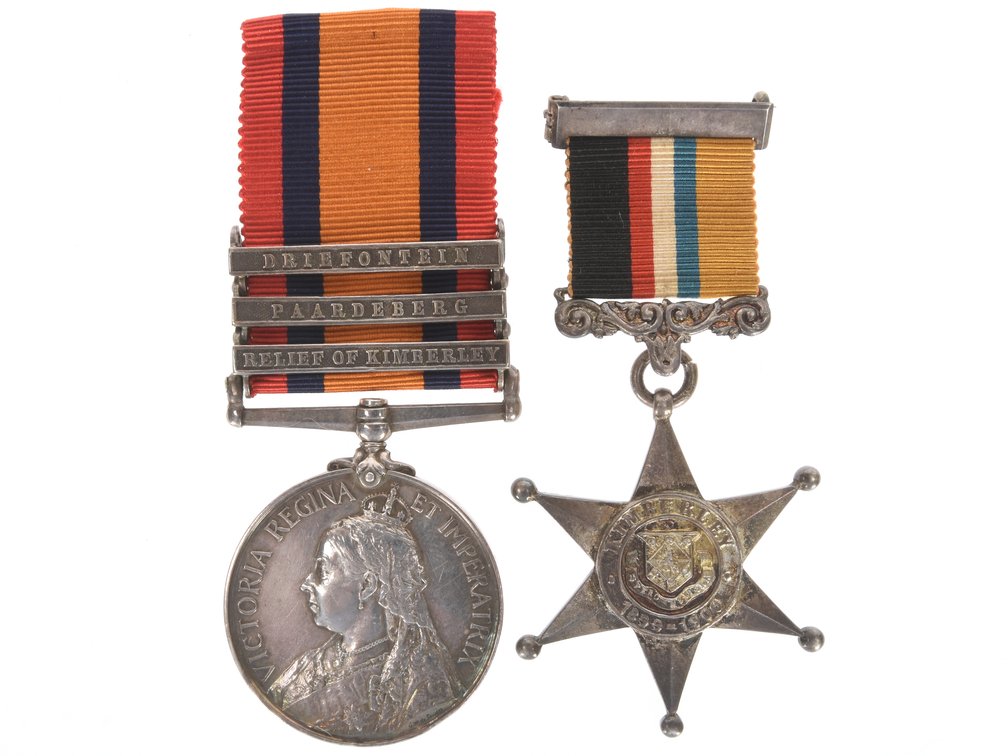
#194 • Queen's South Africa Medal and Kimberly Star-Essex Regiment
Part of British & World Medals (live auction by Bannerman Auctions)
High bid $450.00
Status: SOLD
Queen's South Africa Medal and Kimberly Star-Essex Regiment British Queen's South Africa Medal- with 3 clasps/bars being "RELIEF OF KIMBERLEY", "PAARDEBERG", and "DRIEFONTEN". Medal named (officially impressed) on rim "1480 PTE H. SIMLICK, I: ESSEX REGT" in capital block letters. Medal exhibits even dark toning, some light abrasions and edge knocks and is in fine condition. Medal presents proper ribbon. Simlick appears on medal rolls and is entitled to the three bars on this medal. QSA accompanied by Kimberly Star medal (Mayor's Siege Medal 1900). with original ribbon and silver brooch bar at top. Approximately 5,000 stars were awarded. There is no roll of recipients. Star presents hallmarks for Birmingham 1900 on reverse of star. Estimate: $600 - $900 Historical Background: The Queen's South Africa Medal is a circular silver campaign medal, 1.42 inches in diameter, that was authorized in 1900 for service during the Second Boer War. It was awarded to all who served in South Africa between October 11, 1899, and May 31, 1902. The obverse features a crowned and veiled effigy of Queen Victoria, with the legend "VICTORIA REGINA ET IMPERATRIX." The reverse depicts Britannia with a flag, troops marching to the coast in the right background, and two men-of-war in the left background, with the words "SOUTH AFRICA" around the top perimeter. The ribbon is 1.25 inches wide, consisting of five stripes: red, dark blue, an orange center, dark blue, and red. Twenty-six different clasps were authorized to be worn on the ribbon, indicating participation in specific actions and campaigns of the Second Boer War. These clasps were organized into three groups: Battle, State, and Date clasps, such as Elandslaagte, Defence of Ladysmith, Orange Free State, and Relief of Ladysmith. Approximately 178,000 of these medals were issued. The first medals awarded bore the dates 1899 and 1900 on the reverse, but these dates were removed from subsequent medals as the war continued past 1900. The Essex Regiment played a significant role in the Second Boer War (1899–1902), committing its 1st, 2nd, 3rd (Militia), and Volunteer Battalions to the conflict. The 1st Battalion deployed early, arriving in December 1899 and serving near Colesburg before joining Lord Roberts' advance. They were integral to major British successes, participating in the Relief of Kimberley and the intense Battle of Paardeberg in February 1900. During the fighting at Paardeberg, Lieutenant Parsons earned the Victoria Cross for conspicuous courage. The 1st Battalion later distinguished itself with a bayonet charge at Driefontein, receiving special commendation from Lord Roberts. They continued fighting through the occupation of Johannesburg and Pretoria, and subsequent actions at Diamond Hill and Belfast. The 2nd Battalion, though represented by mounted infantry units earlier, arrived in full strength in December 1901. Their main function during the latter stages of the war was crucial, involving the construction and occupation of blockhouse lines across the Orange River Colony to restrict Boer movement. The 3rd Battalion and volunteer service companies also contributed by holding blockhouse lines and guarding the lengthy lines of communication. The regiment ultimately gained the battle honor South Africa 1900–02 for its widespread and arduous service, which concluded with the 1st Battalion transferring to India and the 2nd Battalion returning home in late 1902.