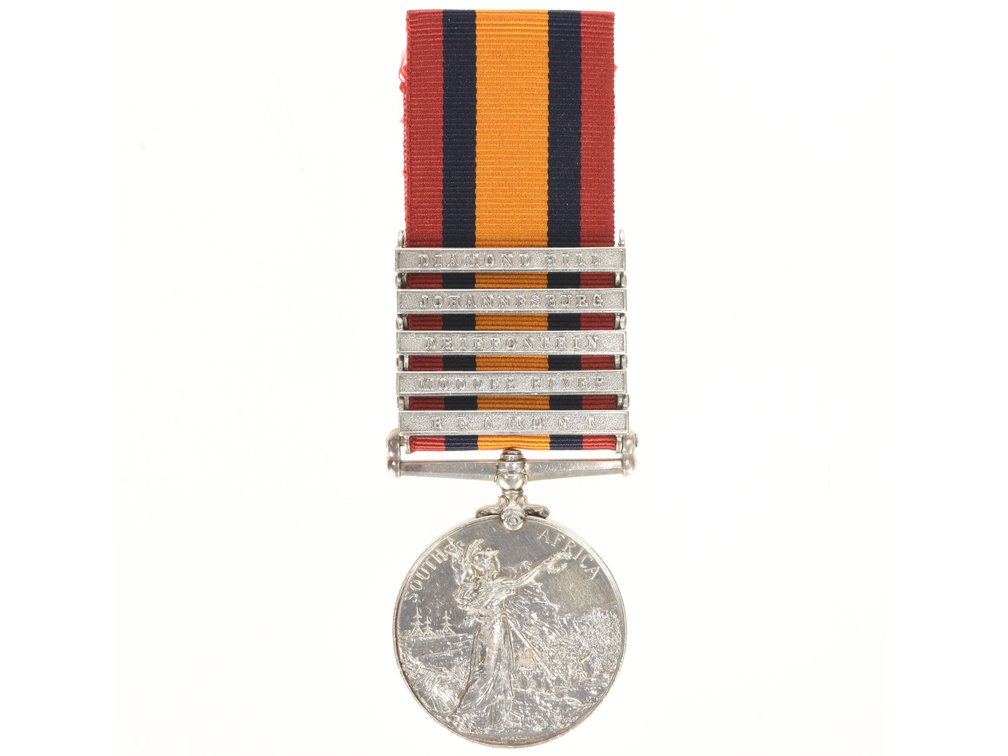
#195 • Queen's South Africa Medal: Coldstream Guards
Part of British & World Medals (live auction by Bannerman Auctions)
High bid $130.00
Status: SOLD
Queen's South Africa Medal: Coldstream Guards British Queen's South Africa Medal- with 5 clasps/bars being "BELMONT", "MODDER RIVER", "DRIEFONTEIN", "JOHANNESBURG" and "DIAMOND HILL". Medal named (officially impressed) on rim "1349 PTE W.E. BRIDER, CLDSTM: GDS:" in capital block letters. Medal exhibits even toning, some polishing wear, surface abrasions and is in fine condition. Medal presents proper ribbon. William Edward Brider, a servant by trade, enlisted on January 19, 1898 and served until discharged on January 16, 1910. Estimate: $200 - $400 Historical Background: The Queen's South Africa Medal is a British campaign medal authorized in 1900 for service during the Second Boer War, which lasted from 1899 to 1902. It was awarded to all British and Colonial military personnel, including Canadians and Australians, who served in South Africa between 11 October 1899 and 31 May 1902. The medal is a circular disk, 38 millimeters in diameter, typically struck in silver, though a bronze version was issued primarily to non-combatant Indian troops. The obverse features a crowned and veiled effigy of Queen Victoria facing left, inscribed with VICTORIA REGINA ET IMPERATRIX. The reverse, designed by G W de Saulles, depicts Britannia holding the Union Flag and extending a laurel wreath toward advancing troops, with two men-of-war shown in the background and the words SOUTH AFRICA above. The ribbon for the medal is 1.25 inches wide and is characterized by a broad orange central stripe flanked by dark blue stripes and red edges. A total of twenty-six clasps were authorized and awarded to denote participation in specific battles, state campaigns, or periods of service, such as Cape Colony, Orange Free State, and Transvaal. Three distinct reverse types of the medal exist, primarily differing in the presence or absence of the dates 1899 to 1900. The initial medals bore these dates, but they were later machined off or omitted in subsequent mintings after the war extended past 1900. Historically, 3,860 of these medals were awarded to Canadians serving in units from or recruited in Canada. The Coldstream Guards played a significant role in the Second Boer War (1899-1902), deploying their 1st and 2nd battalions to South Africa at the conflict's outset. Both battalions were part of the 1st Guards Brigade, which joined the force tasked with relieving the siege of Kimberley. The 1st Battalion sailed on the transport ship Malta, and the 2nd Battalion arrived shortly after on the Gascon. The regiment quickly saw action in several major engagements during the conventional phase of the war, notably the battles of Belmont and Modder River, and suffered significant losses during the defeat at Magersfontein in December 1899. As the conflict progressed into a guerrilla war phase, the Coldstream Guards adapted their role, with some members serving in mounted infantry units. They participated in mobile columns and garrison duties across the Cape Colony until the war concluded in May 1902. The battalions took part in major advances toward Bloemfontein, Pretoria, and Koomati Poort. A memorial was later erected to commemorate the officers and 207 non-commissioned officers and men of the Coldstream Guards who died while serving the Empire during the South African War.