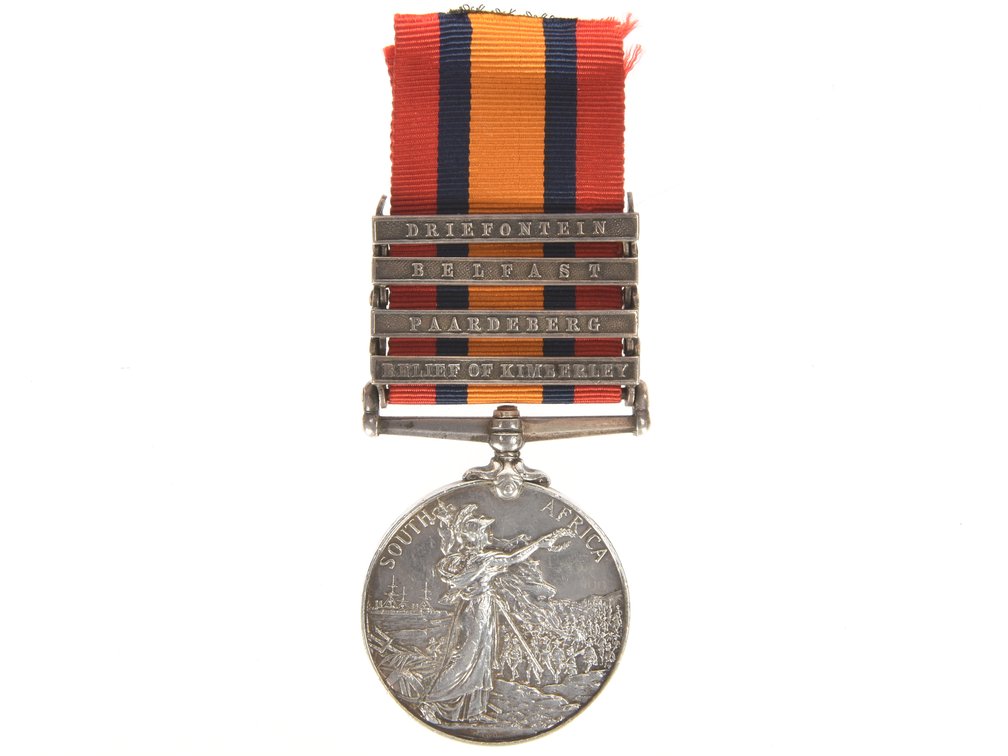
#192 • Queen's South Africa Medal - Yorkshire Regiment
Part of British & World Medals (live auction by Bannerman Auctions)
High bid $140.00
Status: SOLD
Queen's South Africa Medal - Yorkshire Regiment British Queen's South Africa Medal- with 4 clasps/bars being "RELEIF OF KIMBERLY", "PAARDBERG", "BELFAST", and "DRIEFONTEIN". Medal named (officially impressed) on rim "5859 PTE F. PRINCE, YORKSHIRE REGT." in capital block letters. Medal exhibits even toning, some polishing wear, slight abrasions and is in fine condition. Medal presents proper ribbon. Estimate: $200 - $400 Historical Background: The Queen's South Africa Medal is a military campaign medal authorized in 1900 for those who served in South Africa during the Second Boer War, between October 11, 1899, and May 31, 1902. It is a circular, silver medal, 1.42 inches in diameter. The obverse features a crowned and veiled effigy of Queen Victoria facing left, with the legend "VICTORIA REGINA ET IMPERATRIX." The reverse depicts Britannia holding a flag and a wreath, with troops marching to the coast and men-of-war in the background, and the words "SOUTH AFRICA" around the top perimeter. The ribbon is 1.25 inches wide, consisting of five stripes: red, dark blue, orange center, dark blue, and red. Twenty-six different clasps were awarded with the Queen's South Africa Medal to signify participation in specific battles, actions, or campaigns of the Second Boer War. These clasps fall into three categories: Battle, State, and Date clasps. Examples of clasps include "Rhodesia," "Relief of Mafeking," "Defence of Ladysmith," "Paardeberg," "Orange Free State," and "South Africa 1902." The maximum number of clasps awarded to any one recipient was nine. The first medals awarded, specifically to the Lord Strathcona's Horse, included the dates 1899 and 1900 on the reverse, but these dates were removed from subsequent medals as the conflict extended beyond 1900. The 1st Battalion of the Yorkshire Regiment began its service in the Second Boer War after being diverted from Sir Charles Warren's Vth Division and deployed to the Colesberg district. There, they successfully assisted General French in repelling the Boer invasion alongside the 1st Welsh and 1st Essex regiments. In February 1900, the battalion was transferred to the 18th Brigade under Brigadier Stephenson, joining the VIth Division for Lord Roberts' major offensive effort. They immediately faced severe combat at the Battle of Paardeberg on February 18th, sustaining significant casualties including 31 men and 1 officer killed and over 100 men wounded. During this battle, Sergeant Alfred Atkinson earned a posthumous Victoria Cross for repeatedly exposing himself to heavy fire to retrieve water for the wounded. Following their initial severe engagements, the 1st Yorkshire Battalion continued service as part of the 18th Brigade, joining the XIth Division under Lieutenant General Pole-Carew. This brigade maintained a high honor post throughout the advance to Pretoria, participating in the relief of Wepener and the eastern movement toward Koomati Poort. Although their subsequent active combat roles were limited, often relegated to garrison duties in the Eastern Transvaal during the final phase of the war, they faced serious challenges from disease. In the first half of 1901, particularly at Koomati Poort, over 50 percent of the battalion was hospitalized due to fever. Despite these difficulties, the regiment secured several mentions in Lord Kitchener's despatches for exceptional work, mainly involving their Mounted Infantry components.