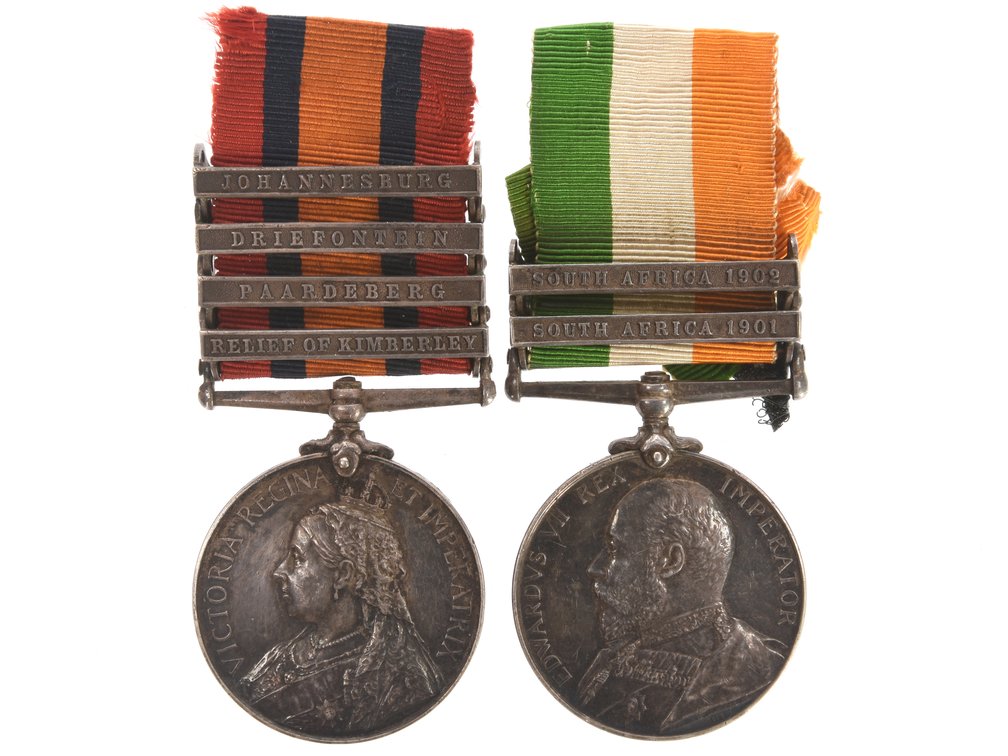
#193 • Queen's South Africa Medal & King's South Africa Medal: East Kent Regiment (the Buffs)
Part of British & World Medals (live auction by Bannerman Auctions)
High bid $250.00
Status: SOLD
Queen's South Africa Medal & King's South Africa Medal: East Kent Regiment (the Buffs) British Queen's South Africa Medal- with 4 clasps/bars being "RELIEF OF KIMBERLEY", "PAARDEBERG", "DRIEFONTEN" and "JOHANNESBURG". Medal named (officially impressed) on rim "5272 PTE. P. RILEY, EAST KENT REGT." in capital block letters. Medal exhibits even dark toning, some light abrasions and edge knocks and is in fine condition. Medal presents proper ribbon. Sold with British King's South Africa Medal- with 2 clasps/bars being "SOUTH AFRICA 1901", and "SOUTH AFRICA 1902". Medal named (officially impressed) on rim "5272 PTE. P. RILEY, E. KENT REGT." in capital block letters. Medal exhibits even dark toning, some light abrasions and edge knocks and is in fine condition. Estimate: $400 - $600 Historical Background: The Queen's South Africa Medal is a circular silver military campaign medal that was authorized in 1900 for those who served in South Africa during the Second Boer War, specifically between 11 October 1899 and 31 May 1902. The obverse of the medal features a crowned and veiled effigy of Queen Victoria facing left, with the legend "VICTORIA REGINA ET IMPERATRIX" around the upper perimeter. The reverse depicts Britannia with the words "SOUTH AFRICA" around the top. The first medals awarded bore the dates 1899 and 1900 below Britannia's wreath, but these dates were removed from subsequent medals because the conflict continued beyond 1900. The medal was awarded to British and Colonial forces, including approximately 3,860 Canadians. It was issued with up to twenty six clasps, which indicate participation in specific actions and campaigns of the war. These clasps were categorized as Battle, State, and Date clasps. The ribbon for the medal is 1.25 inches wide and consists of five stripes: red, dark blue, orange center, dark blue, and red. The maximum number of clasps awarded to any one recipient was nine. The Buffs, officially known as The Buffs (Royal East Kent Regiment), stand as one of the oldest infantry regiments in the British Army, tracing their origins back to 1572 as Thomas Morgan's Company of Foot. For centuries, the regiment was recognized as the 3rd Regiment of Foot, or 'The Buffs,' a nickname derived from the distinctive creamy buff-colored uniform facings and leather coats worn by their soldiers. Garrisoned traditionally in Canterbury, the regiment solidified its county association with East Kent in 1782 and accumulated 116 battle honors across major conflicts including the American War of Independence, the Napoleonic Wars, and the Crimean War. The regiment's primary involvement in the Second Boer War (1899–1902) was conducted by the 2nd Battalion, which arrived in South Africa in January 1900 as part of the 13th Brigade of the VIth Division. The Buffs participated in key engagements during the early British offensive, fighting notably at Paardeberg and Driefontein in the advance toward Bloemfontein. Later, the regiment served in various mobile columns during the guerrilla phase of the war, though records indicate challenges in performance during engagements such as the attack at Baakenlaagte in October 1901. Both the regular and auxiliary battalions supplied men to the front, and the regiment suffered casualties from combat and disease until the Treaty of Vereeniging ended the conflict in May 1902.