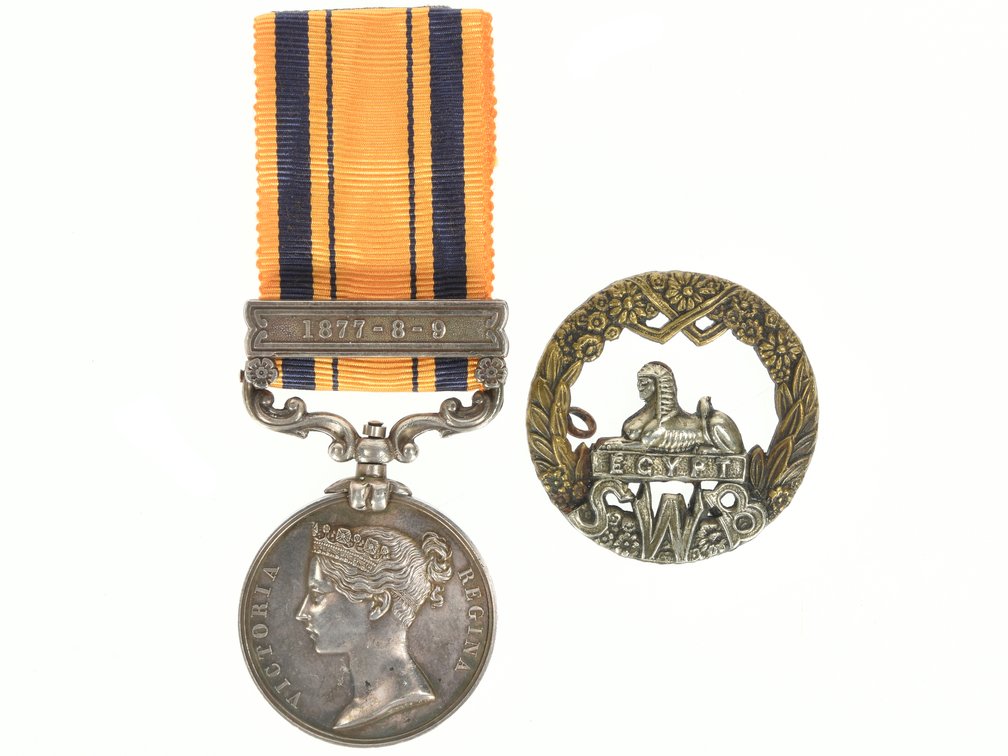
#168 • South Africa (1877-1879) Medal - 24th Regiment of Foot (South Wales Borderers)
Part of British & World Medals (live auction by Bannerman Auctions)
High bid $600.00
Status: SOLD
South Africa (1877-1879) Medal - 24th Regiment of Foot (South Wales Borderers) British South Africa 1877-79 campaign medal with 1 bar/clasp being "1877-8-9". Medal named (engraved) on rim "1743 PTE W. BATES 1-24TH FOOT" in block capital letters. Medal exhibits even toning, minimal polishing wear and is in excellent condition. Medal presents proper ribbon. Private Bates appears on the rolls - fortunately for him, albeit perhaps inconveniently for collectors, he was not at the Battle of Isandlwana. Reverse side of ribbon has a patch of velcro from where the former owner had this mounted in a frame. We left it in place since once removed, it leaves a tacky residue that is frankly more offensive than the velcro itself. So, the next owner may decide for themselves whether to re-ribbon or leave it as-is and perhaps also utilize this method of suspension in a display setting. Sold with hat insignia (late 19th/early 20th century) of the South Wales Borderers regiment. Estimate: $700 - $1000 Historical Background: The South Africa Medal (1880), also known as the South Africa (1877-1879) Medal, was established on 1 August 1880 for British forces and Colonial volunteers who participated in various campaigns in South Africa between 1877 and 1879. These campaigns included the Gaika-Gcaleka War, the Griqua War, the Anglo-Zulu War of 1879, and actions against Chiefs Pokwane, Sekhukhune, and Moirosi. A total of circa 36,600 medals were awarded, with only one clasp ever being issued with each medal to denote service in a specific year or period of years. The medal features a portrait of Queen Victoria on the obverse, typically with the legend 'VICTORIA REGINA'. The reverse displays a crouching lion drinking, with a bush in the background, and an exergue showing a Zulu ox-hide shield crossed with four assegais, along with the legend 'SOUTH AFRICA'. The medal was fitted with a buff ribbon that has two broad blue stripes near the edge and two narrow inner ones. Clasps were issued to signify participation in specific campaigns during the 1877 to 1879 period. The 24th Regiment of Foot, later known as the South Wales Borderers, holds a distinguished place in British military history, particularly for its involvement in the conflicts of the British Empire. Prior to the Second Boer War, the regiment was already famous for its service and casualties during the Anglo-Zulu War, most notably at the battles of Isandlwana and Rorke's Drift in 1879. These events cemented the regiment's reputation for courage and tenacity under extreme duress, making it one of the most recognized units in the Victorian army. During the Second Boer War, which spanned from 1899 to 1902, the regiment saw active service across South Africa. It participated in various engagements and operations against the Boer forces, contributing to the ultimate British victory. The fighting was often characterized by difficult terrain and guerrilla tactics, demanding adaptability and resilience from the British troops. The South Wales Borderers performed their duties with the professionalism expected of a veteran regiment throughout the long and arduous campaign.