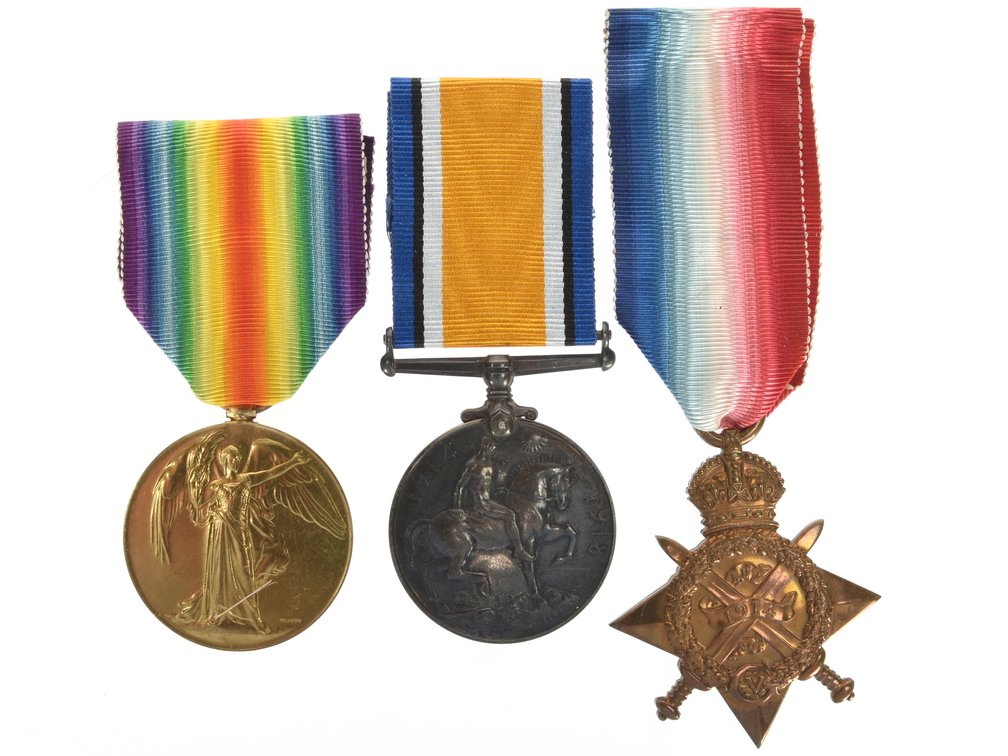
#260 • World War I Trio Medals: 6th Dragoons (Inniskilling)
Part of British & World Medals (live auction by Bannerman Auctions)
High bid $140.00
Status: SOLD
World War I Trio Medals: 6th Dragoons (Inniskilling) British World War I trio medal group including: 1.) Aug-Nov 1914 Star Medal (Mons Star) named (impressed) on reverse "2408 PTE. A.E. BOARDMAN. 6/DNS:" in block capital letters . Medal exhibits even toning, and is in extra fine condition. Medal presents proper ribbon. 2.) World War I Service Medal named (impressed) on rim "D-2408 PTE. A.E. BOARDMAN. 6-DNS." in block capital letters .Medal presents proper ribbon. Medal exhibits dark even toning, and is in extra fine condition. and 3.) British World War I Victory Medal named (impressed) on rim "D-2408 PTE. A.E. BOARDMAN. 6-DNS." in block capital letters . Medal exhibits even toning, and is in extra fine condition. Medal presents proper ribbon. Arthur E. Boardman enlisted in the 6th (Inniskilling) Dragoons on October 5, 1914 he was entitled to the rosette/bar to the Mons Star medal however group lacks this device. Estimate: $120 - $180 Historical Background: The World War I Trio Medals refer to the three main campaign medals awarded to British and Imperial servicemen who fought during the First World War. These medals include the 1914 Star or the 1914-15 Star, the British War Medal, and the Victory Medal. They were given to soldiers automatically and did not require an application process. The set represented recognition for service and participation in the Great War. The trio quickly acquired the popular nickname "Pip, Squeak and Wilfred," a reference to a well-known comic strip of the time featuring a dog, a penguin, and a baby rabbit. Each medal had a distinct design and purpose, marking service in different theaters or timeframes of the war. When the British War Medal and the Victory Medal were worn alone, they were sometimes known as "Mutt and Jeff." The 6th (Inniskilling) Dragoons was a cavalry regiment of the British Army that served on the Western Front during World War I. At the outbreak of the war in August 1914, the regiment was part of the 3rd Cavalry Brigade, 2nd Cavalry Division, and immediately deployed to France as part of the British Expeditionary Force (BEF). They were involved in the early battles of the war, including the Battle of Mons and the subsequent Great Retreat, playing a role typical of cavalry in the opening mobile phase of the conflict. As the war settled into trench warfare, the opportunities for traditional cavalry charges diminished significantly. Throughout the majority of the war, the regiment often served dismounted, performing duties in the trenches as infantry, a common experience for cavalry units on the Western Front after 1914. However, they retained their horses and were held in reserve, ready for any potential breakthrough in the static lines. The 6th Dragoons participated in key engagements such as the First Battle of Ypres. They were eventually mechanized and converted into a machine gun unit late in the war, contributing to the final advances of 1918 before the Armistice.