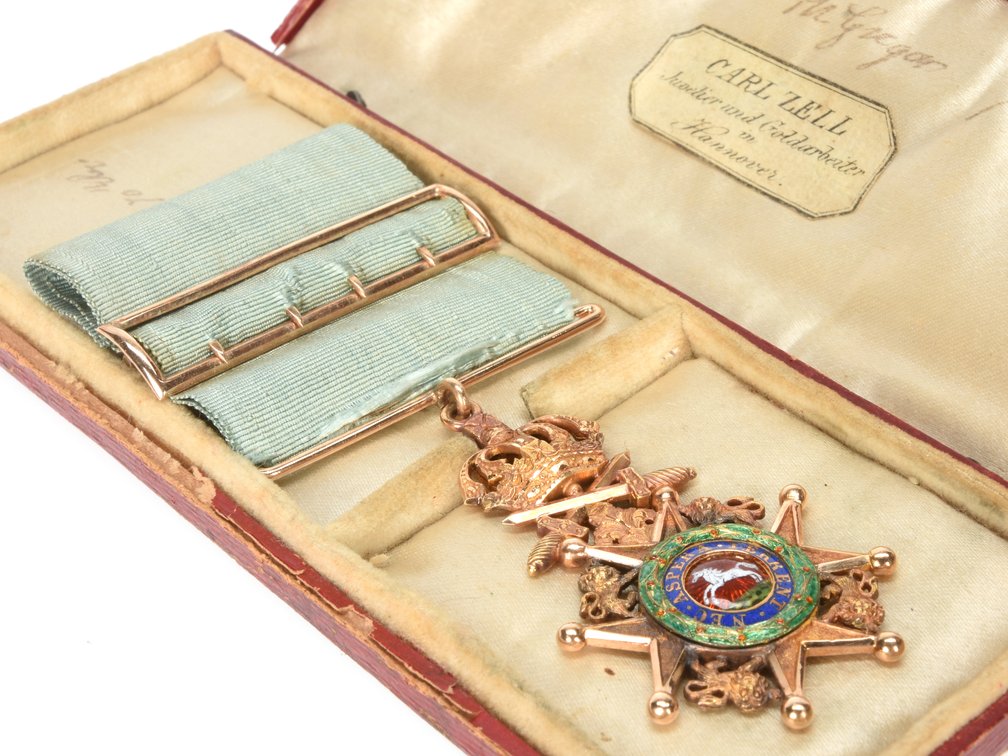
#146 • Royal Hanoverian Guelphic Order: Lieutenant Colonel McGrigor 70th Regiment of Foot
Part of British & World Medals (live auction by Bannerman Auctions)
High bid $4,100.00
Status: SOLD
Royal Hanoverian Guelphic Order: Lieutenant Colonel McGrigor 70th Regiment of Foot. Cased knight's badge/medal of the Royal Hanoverian Guelphic Order (Military Division) in gold with fine enameling. Badge/medal housed in case with maker's label "Carl Zell, Jeweler & Goldworker, Hanover" on interior of lid. Manuscript ink inscription on interior of lid reads "Lt. Col. McGregor 70th Regt". on silk of medal bed. Medal/badge measures 2.25" x 1.25" with box measuring 5.75" x 2.25". Box exhibits some wear with losses and split leather hinge. Charles McGrigor (or McGregor) (1778-1841)was born in Aberdeen, Scotland. In 1794 McGrigor purchased an Ensigncy in the 97th Regiment of Foot and subsequently exchanged into the 33rd Regiment of Foot then serving in India under the future Duke of Wellington. In 1785 McGrigor purchased a Lieutenancy in the 33rd Regiment of Foot and served in numerous engagements in India until his ill health required his return to Europe in 1801. In late 1801 he purchased a company of the 90th Regiment of Foot and accompanied that unit to the West Indies in 1804. In 1806 McGrigor was appointed to the Quartermaster-General's department and from 1809-10 served as chief assistant in that department at the capture of the islands of Martinique (McGrigor receives brevet rank of Major for his actions) and Guadeloupe (McGrigor receives accolades from Commander-in Chief Sir George Beckwith). He continued to serve in the West Indies until his health again required him to return to England. In 1812 he was made Major of the 63rd Regiment of Foot and he was exchanged into the 70th Regiment of Foot that embarked for Canada in 1813. In 1814 McGrigor was breveted Lieutenant-Colonel of the regiment and in 1823, after 31 years of service, he purchased the Lt.Colonelcy of the 70th. He remained in command of the regiment until in 1829, after 37 years of service and his ill health he retired. Upon his retirement McGrigor was conferred the order and title of Knight of the Royal Hanoverian Guelphic Order by King George IV as appreciation of his service and meritorious career. After a short time he partially recovered his health and missing military service took the position of Barrack-Master of Nottingham. He died while serving in this position on March 15, 1841 in Nottingham, England. Estimate: $3000 - $4000 Historical Background: The Royal Hanoverian Guelphic Order, often simply called the Royal Guelphic Order, was established on 28 April 1815 by the Prince Regent, who later became King George IV of the United Kingdom. It was a house order of the Kingdom of Hanover, taking its name from the House of Guelph, a branch of which was the House of Hanover. Because the monarchs of Hanover and the United Kingdom were shared until 1837, the order was frequently bestowed upon British subjects and included grades such as Knight Grand Cross (GCH), Knight Commander (KCH), and Knight (KH) in its original structure. After the Kingdom of Hanover was annexed by the Kingdom of Prussia in 1866, the Royal Guelphic Order continued to be awarded by the Royal House of Hanover as a house order. Its motto is "Nec Aspera Terrent," which translates to "Not afraid of difficulties." Today, the order's current Sovereign is the head of the Hanoverian house, Ernst August, Prince of Hanover. The 70th Regiment of Foot was a British Army regiment that saw service during the Napoleonic Wars. It was established in 1758 and carried a lineage that involved various restructurings and title changes over its history. During the critical period of the Napoleonic Wars, the regiment contributed to the wider British military effort against the French Empire, participating in campaigns and battles across different theaters of war, though it was not always at the forefront of the most famous engagements in the Peninsula. The regiment's commitment to service reflected the broader organizational structure and function of the British infantry during this era. They would have been tasked with standard infantry duties, including drill, maneuvering, and engaging enemy forces in line formation. Their participation in the Napoleonic conflicts cemented their place in the history of the British Army before the eventual merging and renaming of units that occurred later in the 19th century.