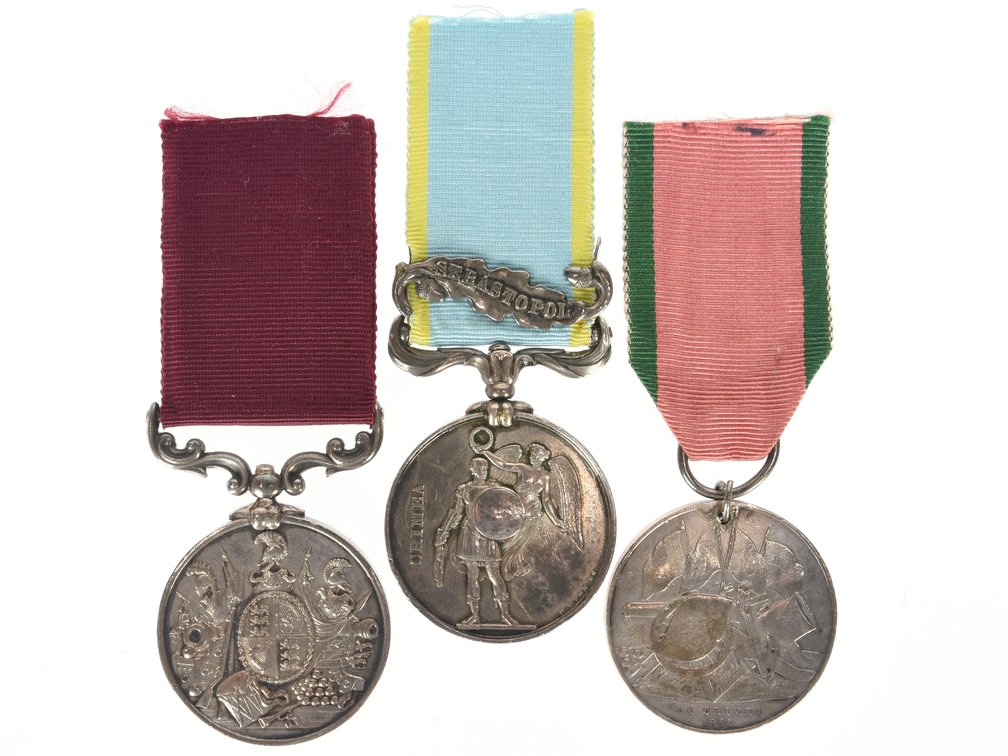
#158 • Crimean War Medals - 10th Royal Hussars (Prince of Wales's Own)
Part of British & World Medals (live auction by Bannerman Auctions)
High bid $250.00
Status: SOLD
Crimean War Medals - 10th Royal Hussars (Prince of Wales's Own) Group of 3 Crimean War medals including; 1.) British Crimea campaign medal with 1 clasp/bar being "SEBASTOPOL". Medal is unnamed. Medal exhibits toning (spotting), polishing wear, some edge knocks and is in good condition. Medal presents proper ribbon. 2.) Turkish Crimean medal. Medal is unnamed. Medal shows ball mount at 12 o'clock broken off and medal subsequently holed at upper rim to accommodate mount and jump rings. Medal exhibits even toning, some polishing wear, some edge knocks and is in good condition. Medal presents proper ribbon. 3.) British Long Service and Good Conduct medal. Medal named (impressed) on rim "853 PTE JOHN PARNABY 10TH HUSSARS" in block capital letters. Medal exhibits even dark toning, some polishing wear, some edge knocks and is in verry good condition. Medal presents proper ribbon. Reverse of ribbons exhibit glue residue from previous mounting/framing. Private John Parnaby, of the 10th Royal Hussars was a farmer from Yorkshire when he enlisted on June 25, 1845. He was discharged March 29, 1870 after serving 24 years and 278 days earning 5 Good Conduct badges. Parnaby served from August 26, 1846 to April 16, 1855 in the East Indies. He subsequently served in the Crimea and Turkey from April 17, 1855 thru July 31, 1856. He never rose above the rank of private. Estimate: $400 - $700 Historical Background: The 10th Royal Hussars (Prince of Wales's Own) was a cavalry regiment of the British Army, originally raised as a dragoon unit in Hertfordshire in 1715 during the First Jacobite Rebellion. It was ordered by King George III to switch from dragoons to light dragoons in 1783, eventually becoming a hussar regiment. The regiment was known by nicknames such as "Baker's Light Bobs," "The Chainy 10th," and "The Shiny 10th," and adopted the motto "Ich Dien" (I Serve). Throughout its history, it served in major conflicts, including the Crimean War, and later the Napoleonic Wars. During the First World War, the 10th Royal Hussars fought in key battles such as Ypres, Loos, Arras, and Amiens. Following the war, the regiment served on peacekeeping duties in Ireland and later had a brief spell in Egypt and India. Returning to England, the unit mechanized and joined the Royal Armoured Corps. The regiment ceased to exist under its original name in 1969 when it was merged with the 11th Hussars to form The Royal Hussars (Prince of Wales's Own). This successor armored regiment continued to serve until 1992, when it was merged into The King's Royal Hussars. The 10th Royal Hussars (Prince of Wales's Own) was a British Army cavalry regiment raised in 1715. It later became Britain's first hussar regiment. The unit served in many campaigns throughout its history until 1969, when it was integrated into The Royal Hussars (Prince of Wales's Own). It earned nicknames such as "Baker's Light Bobs," "The Chainy 10th," and "The Shiny 10th," and its motto was "Ich Dien" (I Serve). During the Victorian era, the regiment was deployed to India in the 1840s and subsequently saw action in the Crimean War. The 10th Royal Hussars participated in the Siege of Sevastopol, with fighting reported at the Battle of Eupatoria and Kerch. Following their service, the regiment was renamed in 1861 to the 10th (The Prince of Wales's Own) Royal Hussars.