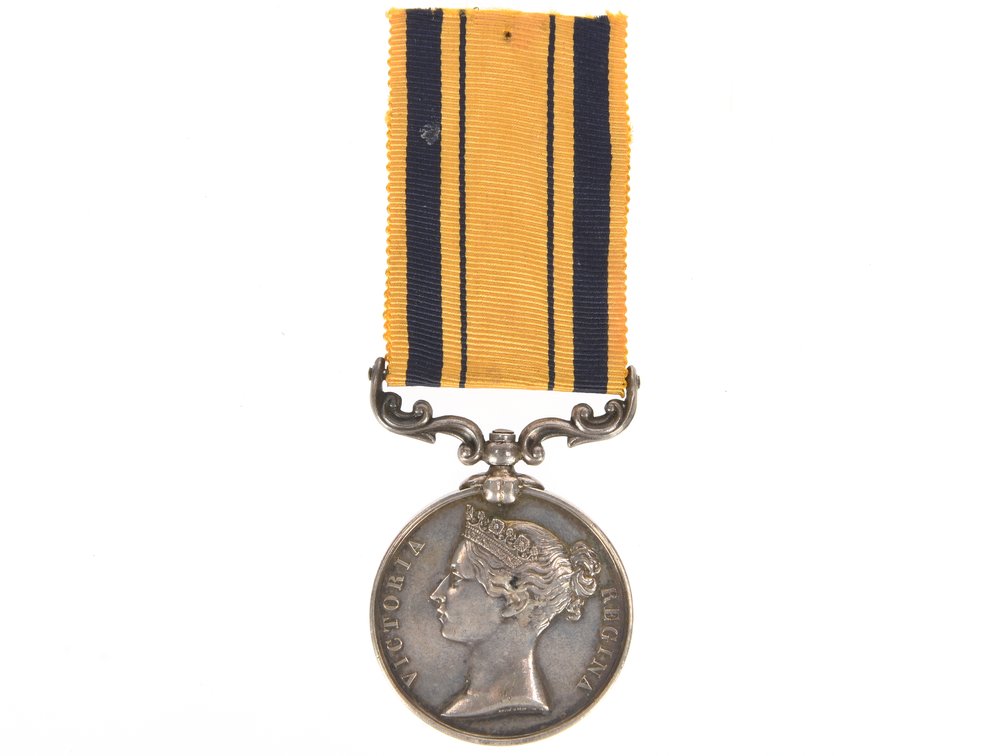
#169 • South Africa (1877-1879) Medal - Royal Engineers
Part of British & World Medals (live auction by Bannerman Auctions)
High bid $190.00
Status: SOLD
South Africa (1877-1879) Medal-Royal Engineers British South Africa 1877-79 campaign medal with no bar/clasp. Medal named (engraved) on rim "14031 SAPPER, C. WARWICKER. R.E." in sloping serif capital letters. Medal exhibits even toning, some polishing wear, surface abrasions, several edge knocks and is in very good condition. Medal presents proper ribbon. As medal lacks clasp this was issued for service during the Zulu campaign period (11th January -1st September 1879) but the recipient remained on the Natal side of the Tugela River. Estimate: $200 - $300 Historical Background: The South Africa Medal (1880), often referred to as the Zulu War Medal, is a campaign medal was awarded to officers and men of the British Army and Colonial forces who took part in various conflicts in South Africa between 1877 and 1879. These campaigns include the Gaika-Gcaleka War (1877-1878), the Griqua War (1878), the actions against Chief Pokwane and Chief Sekhukhune (1878-1879), and most notably, the Anglo-Zulu War (1879). The medal was also issued for the action against the uprising in Basutoland under Chief Moirosi (1879). The medal is a 36-millimetre silver disk featuring the diademed head of Queen Victoria facing left on the obverse. The reverse shows a crouching lion on a plinth in front of a protea bush. Inscribed around the top perimeter is "SOUTH AFRICA," and the exergue features a military trophy consisting of a Zulu ox-hide shield and four crossed assegais. The medal was fitted with a cusped bar and a buff ribbon with two broad blue stripes near the edge and two narrow inner ones. Clasps were issued to denote specific campaigns a recipient participated in, such as '1877-8'. The Royal Engineers were a critical component of the British forces deployed to South Africa in 1877. Their role extended far beyond traditional combat, encompassing vital engineering and logistical tasks necessary for maintaining military operations across challenging terrain. This period in South Africa was marked by escalating tensions and conflicts, including the Xhosa Wars, where the Engineers' skills in infrastructure development and field fortifications were heavily relied upon. Their duties included constructing roads, bridges, and temporary camps, surveying land, and establishing telegraph lines for communication. The year 1877 precedes the more widely known Anglo-Zulu War, but it was a time of significant military buildup and preparation. The presence of the Royal Engineers underscored the British commitment to expanding and securing their territories in the region, providing the essential technical support that enabled the wider army to maneuver and sustain itself effectively.