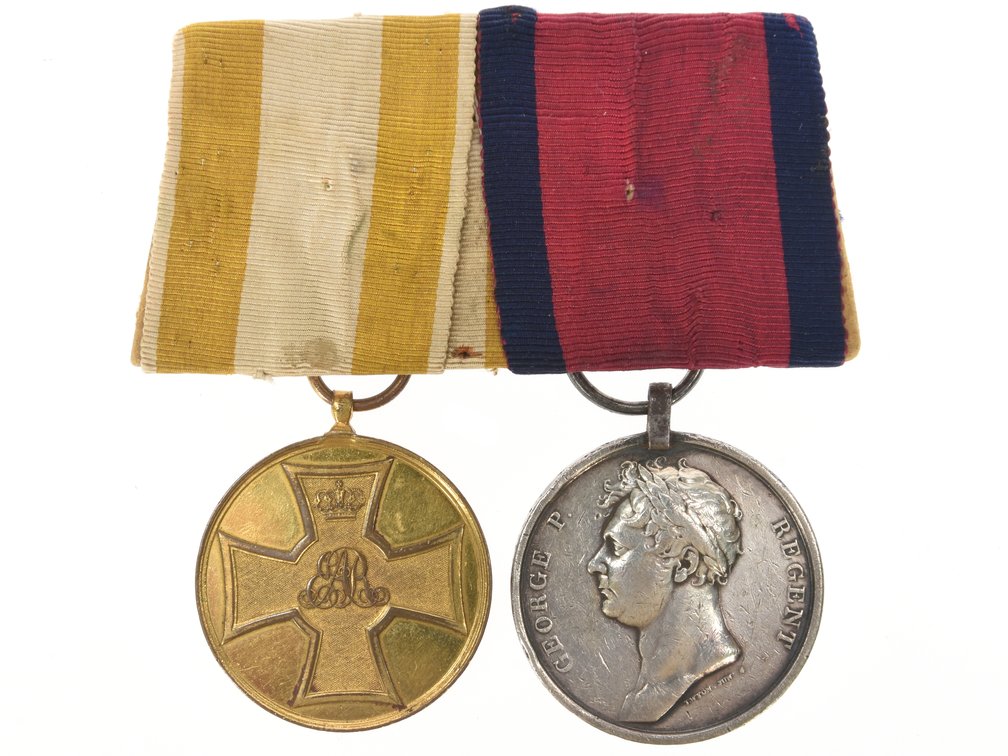
#140 • Waterloo Medal and King's German Legion Volunteers Medal
Part of British & World Medals (live auction by Bannerman Auctions)
High bid $1,900.00
Status: SOLD
Waterloo Medal and King's German Legion Volunteers Medal. Great Britain Waterloo medal and King's German Legion Volunteers medal. Naming on Waterloo medal is officially impressed "HENRY SCHUFT, 3rd. REG. HUSSARS. K.G.L.". Medal presents iron clip and older small suspension ring. Medal exhibits medium polishing wear, some edge knocks and some surface scratches. Waterloo medal mounted on wearing ribbon bar with King's German Legion Volunteers medal in first position. Reverse of ribbon mount shows wear and wire replacement for KGL suspension. The 3rd Hussars, King's German Legion were part of the 7th Cavalry Brigade and suffered significant casualties during the battle of Waterloo. Schuft appears on the Waterloo Medal roll as a private. Estimate: $2000 - $4000 Historical Background: The Waterloo Medal is a campaign medal presented by the United Kingdom of Great Britain and Ireland to all British Army soldiers, regardless of rank, who participated in the battles of Ligny on June 16, 1815, Quatre Bras on June 16, 1815, and Waterloo on June 18, 1815. It was established on April 10, 1816, and was the first campaign medal awarded by the British military. This medal was also the first to be awarded to the families and next-of-kin of soldiers killed in action. Approximately 38,500 medals were awarded, and recipients were often referred to as "Waterloo Men." Its issuance signaled a departure from the British military's prior reluctance to award medals, a common practice among foreign armies at the time. The medal is a silver disk featuring a left-facing effigy of the Prince Regent with the inscription "GEORGE P. REGENT" on the obverse. The reverse displays a figure of Victory seated on a plinth with "WELLINGTON" above, and "WATERLOO" along with the date "JUNE 18 1815" below. Designed by Thomas Wyon, the Chief Engraver to the Royal Mint, the medal set a precedent for future British campaign medals, being the first to be engraved with the soldier's name, rank, and regiment around the rim. It was awarded for campaign service and did not include any clasps. The King's German Legion Volunteers Medal is associated with the King's German Legion (KGL), a unit of the British Army active from 1803 to 1816. The KGL was formed largely by officers and men from the disbanded army of the Electorate of Hanover after its occupation by Napoleonic troops. The Legion comprised approximately 14,000 men and included artillery, cavalry, line infantry, and light infantry, playing a significant role in the Peninsular War and at the Battle of Waterloo in 1815. The unit was highly regarded for its professionalism and loyalty to King George III, who was King of the United Kingdom and Elector of Hanover. The medal itself was awarded to volunteers who served in the King's German Legion. Historical records mention a "Medal for Volunteers in the King's German Legion" awarded by King Ernst August of Hanover in 1841 to survivors of the Battle of Waterloo. Earlier iterations or mentions, such as the "War Medal for Volunteers in King's German Legion 1814," also exist, highlighting the recognition given to those who volunteered for service in this distinguished unit. The medal commemorates the service and achievements of the Hanoverian soldiers who continued to fight for the British Crown after their homeland was lost to Napoleon. The 3rd Hussars, King's German Legion, was a distinguished light cavalry regiment that served with the British Army during the Napoleonic Wars. Formed from German expatriates loyal to the King of Great Britain, who was also the Elector of Hanover, the King's German Legion (KGL) was renowned for its discipline and reliability, making it an essential component of the allied forces. As Hussars, their primary roles included reconnaissance, screening the main army, and engaging in light skirmishes. This regiment is particularly noted for its participation in the Battle of Waterloo in June 1815, where the KGL played a significant role in the allied victory over Napoleon's forces. Their actions demonstrated the KGL's effectiveness in combat, upholding their reputation for courage and tenacity throughout the campaign. The regiment's history remains a testament to the loyalty and service of the German troops within the British military structure of that era.