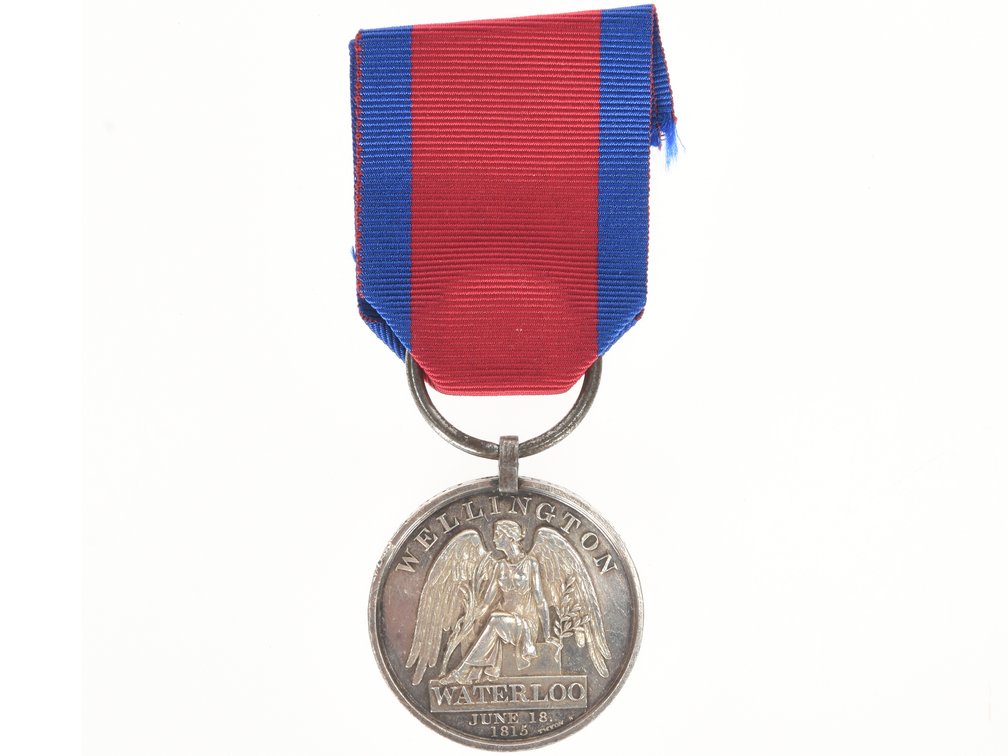
#145 • Waterloo Medal: Royal Artillery
Part of British & World Medals (live auction by Bannerman Auctions)
High bid $1,400.00
Status: SOLD
Waterloo Medal: Royal Artillery Great Britain Waterloo medal. Naming is officially impressed "CORPORAL THOMAS WADE, ROYAL ARTILLERY DRIVERS". Medal presents iron clip and replacement split ring suspension ring. Medal exhibits light polishing wear, some edge knocks (one large one at 6 o'clock) and some light surface scratches. Medal shows modern ribbon for display. Wade served in Captain G. Grime's D troop of artillery. Wade appears on the Waterloo Medal roll as a 2nd corporal. Estimate: $1500 - $3500 Historical Background: The Waterloo Medal is a campaign medal presented by the United Kingdom of Great Britain and Ireland to all British Army soldiers, regardless of rank, who participated in the battles of Ligny on June 16, 1815, Quatre Bras on June 16, 1815, and Waterloo on June 18, 1815. It was established on April 10, 1816, and was the first campaign medal awarded by the British military. This medal was also the first to be awarded to the families and next-of-kin of soldiers killed in action. Approximately 38,500 medals were awarded, and recipients were often referred to as "Waterloo Men." Its issuance signaled a departure from the British military's prior reluctance to award medals, a common practice among foreign armies at the time. The medal is a silver disk featuring a left-facing effigy of the Prince Regent with the inscription "GEORGE P. REGENT" on the obverse. The reverse displays a figure of Victory seated on a plinth with "WELLINGTON" above, and "WATERLOO" along with the date "JUNE 18 1815" below. Designed by Thomas Wyon, the Chief Engraver to the Royal Mint, the medal set a precedent for future British campaign medals, being the first to be engraved with the soldier's name, rank, and regiment around the rim. It was awarded for campaign service and did not include any clasps. Captain G. H. Grimes commanded a detachment of the Royal Artillery Drivers, specifically "D" Troop, during the Battle of Waterloo in 1815. The Royal Artillery Drivers were an essential, though often overlooked, corps responsible for transporting the heavy guns and ammunition that made up the artillery arm of the British Army. Their role was critical in ensuring that the cannons could be positioned and resupplied rapidly on the chaotic battlefield. Grimes's troop would have been instrumental in maneuvering the artillery pieces into effective firing positions against Napoleon's forces. The Battle of Waterloo was the decisive engagement that ended the Napoleonic Wars. The drivers, operating under fire, required significant courage and skill to keep the heavy horses and cumbersome equipment moving across uneven terrain. The service of "D" Troop and Captain Grimes highlights the immense logistical challenges of 19th century warfare, where the ability to quickly deploy and sustain firepower was a major determinant of victory.