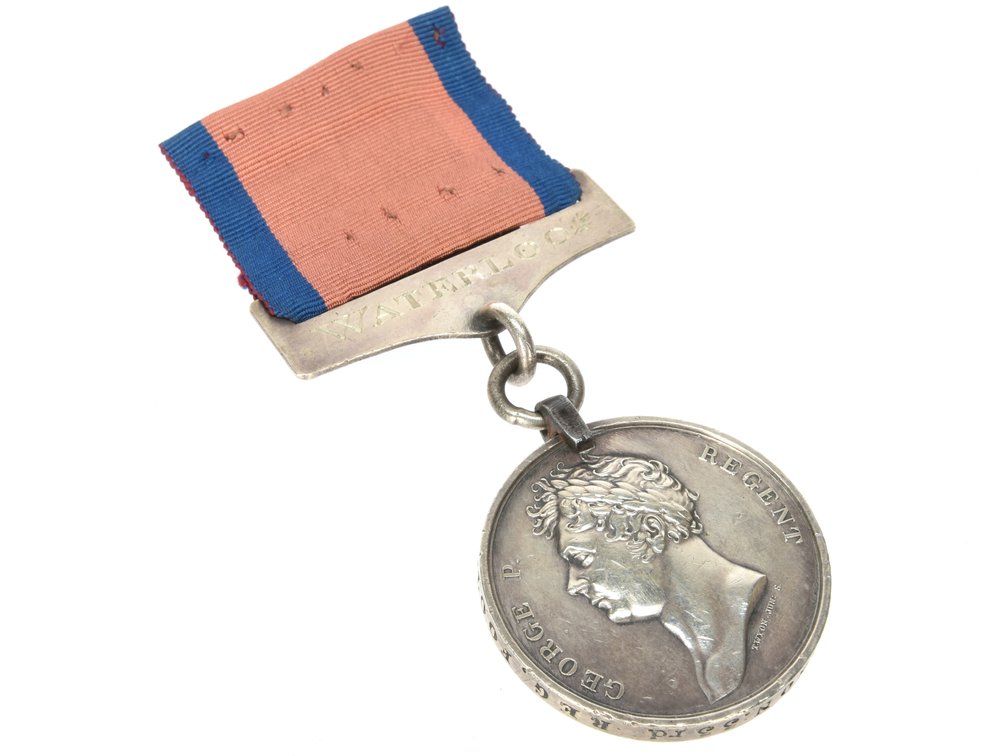
#142 • Waterloo Medal: 33rd Regiment of Foot
Part of British & World Medals (live auction by Bannerman Auctions)
High bid $1,300.00
Status: PASS
Waterloo Medal: 33rd Regiment of Foot. Great Britain Waterloo medal. Naming is officially impressed "DAVID MOULSON. 33rd REG, FOOT". Medal presents iron clip with smaller replaced suspension and jump rings with silver banner type ribbon suspension engraved "WATERLOO". Medal exhibits light polishing wear, some edge knocks and some surface scratches. Medal older ribbon with Velcro backing for mounting. The 33rd (The Duke of Wellington’s) Regiment of Foot was formed in 1702 and serving in North America during the American War of Independence when most of the regiment was captured at Yorktown. The regiment saw subsequent service in South Africa and India before returning to Europe to fight in the Low Countries from 1813 to 1814 against the French, finally being engaged at Waterloo. Moulson appears on the Waterloo Medal roll as a private. Estimate: $2000-4000 Historical Background: The Waterloo Medal is a campaign medal presented by the United Kingdom of Great Britain and Ireland to all British Army soldiers, regardless of rank, who participated in the battles of Ligny on June 16, 1815, Quatre Bras on June 16, 1815, and Waterloo on June 18, 1815. It was established on April 10, 1816, and was the first campaign medal awarded by the British military. This medal was also the first to be awarded to the families and next-of-kin of soldiers killed in action. Approximately 38,500 medals were awarded, and recipients were often referred to as "Waterloo Men." Its issuance signaled a departure from the British military's prior reluctance to award medals, a common practice among foreign armies at the time. The medal is a silver disk featuring a left-facing effigy of the Prince Regent with the inscription "GEORGE P. REGENT" on the obverse. The reverse displays a figure of Victory seated on a plinth with "WELLINGTON" above, and "WATERLOO" along with the date "JUNE 18 1815" below. Designed by Thomas Wyon, the Chief Engraver to the Royal Mint, the medal set a precedent for future British campaign medals, being the first to be engraved with the soldier's name, rank, and regiment around the rim. It was awarded for campaign service and did not include any clasps. The 33rd Regiment of Foot, later known as The Duke of Wellington's Regiment, is one of the most historically significant units in the British Army. Its origins date back to 1702, but it achieved lasting fame through its association with Arthur Wellesley, later the 1st Duke of Wellington. Wellesley began his distinguished military career with the 33rd, commanding it during campaigns in India. His long service with the unit led to its distinctive title and lasting connection to one of Britain’s greatest military leaders. The regiment saw extensive action across various theaters of war throughout the 18th and early 19th centuries, establishing a reputation for discipline and effectiveness. The regiment earned the prestigious battle honor "Waterloo" for its crucial role in the defeat of Napoleon Bonaparte in 1815. At the Battle of Waterloo, the 33rd Regiment of Foot fought bravely as part of the coalition forces. Its participation in this defining moment of European history cemented its legacy and its association with the Duke of Wellington, who commanded the allied forces that day. The unit's long and storied history continued through subsequent conflicts, eventually leading to its amalgamation with other regiments to form the present day Yorkshire Regiment.