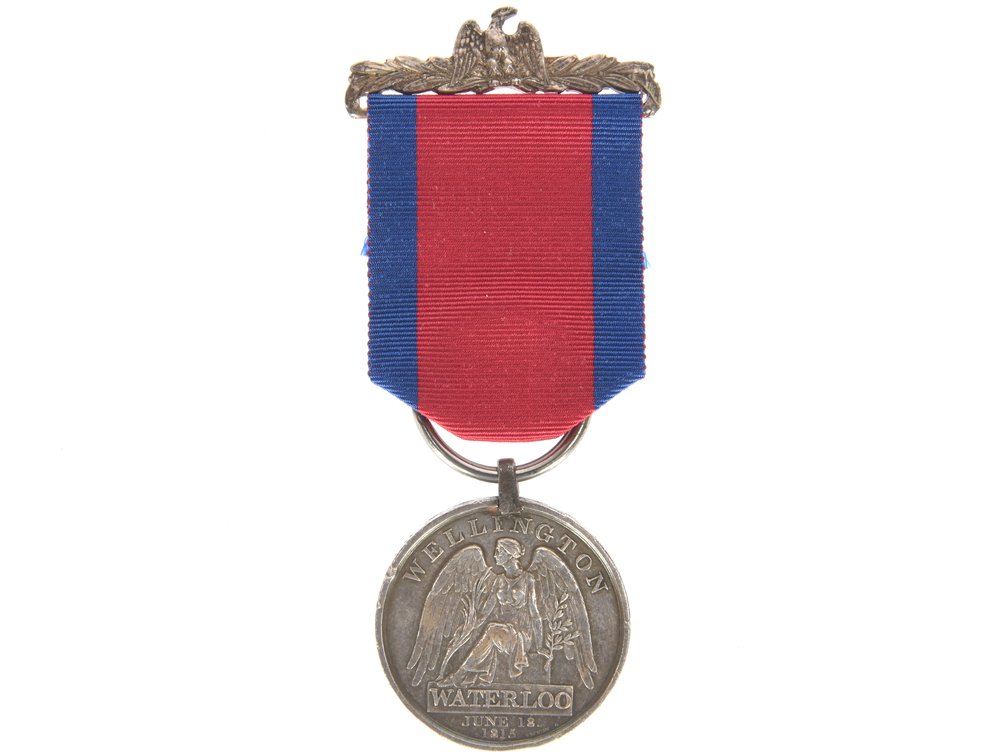
#143 • Waterloo Medal: 6th (Inniskilling) Dragoons
Part of British & World Medals (live auction by Bannerman Auctions)
High bid $2,700.00
Status: SOLD
Waterloo Medal: 6th (Inniskilling) Dragoons Great Britain Waterloo medal. Naming is officially impressed "WILLIAM PENN, 6TH or INNISKILLING DRAG,". Medal presents iron clip and original suspension ring and a top mounting bar with eagle with Bailey maker stamp on reverse with registration date of 1856 (lacks pin). Medal exhibits polishing wear, some edge knocks (one major knock on reverse at 9/10 o'clock) and some surface scratches. Medal shows modern ribbon for display. The 6th/Inniskilling Dragoons were part of the Union Brigade that made a charge at Waterloo. During this charge the brigade captured the Imperial eagle standard of the French 105th Infantry Regiment being one of only 2 Imperial eagles that were captured during the Waterloo campaign. William Penn appears on the rolls as a private. He was born at Grafton, Warwickshire, England and was a hatter before he enlisted on February 28, 1806 at the age of 18. He took part in the charge of the Union Brigade at Waterloo on June 18, 1815. He was discharged on June 4, 1817 at the age of 25 for "Rheumatism and bad health caused by the vicissitudes of heat and cold to which he was exposed in the execution of his duty" as listed in his discharge. During the battle of Waterloo and the Charge of the Union Brigade the 6th Dragoons (Inniskillings) had a casualty rate of 55% . The regiment took to the field with 396 officers and men and at the end of the day 217 officers and men had been killed, wounded or missing. This medal has a record of previous sales starting with Glendining & Co. in March 1976, J. Hawyard in June 1975, Sotheby, Wilkinson & Hodge in June 1906, and Sotheby's in June 1904. Estimate: $2000 - $4000 Historical Background: The Waterloo Medal is a campaign medal presented by the United Kingdom of Great Britain and Ireland to all British Army soldiers, regardless of rank, who participated in the battles of Ligny on June 16, 1815, Quatre Bras on June 16, 1815, and Waterloo on June 18, 1815. It was established on April 10, 1816, and was the first campaign medal awarded by the British military. This medal was also the first to be awarded to the families and next-of-kin of soldiers killed in action. Approximately 38,500 medals were awarded, and recipients were often referred to as "Waterloo Men." Its issuance signaled a departure from the British military's prior reluctance to award medals, a common practice among foreign armies at the time. The medal is a silver disk featuring a left-facing effigy of the Prince Regent with the inscription "GEORGE P. REGENT" on the obverse. The reverse displays a figure of Victory seated on a plinth with "WELLINGTON" above, and "WATERLOO" along with the date "JUNE 18 1815" below. Designed by Thomas Wyon, the Chief Engraver to the Royal Mint, the medal set a precedent for future British campaign medals, being the first to be engraved with the soldier's name, rank, and regiment around the rim. It was awarded for campaign service and did not include any clasps. The 6th Dragoons, also known as the Inniskillings, were a distinguished cavalry regiment of the British Army. They trace their origins back to the late 17th century, though their most famous association is with the Napoleonic Wars. The regiment gained significant recognition for its service and performance during this pivotal era in European history, demonstrating notable courage and effectiveness in combat situations. Their presence at the Battle of Waterloo in 1815 is a central part of their historical legacy. During the battle, the Inniskillings participated in the famous charge of the Union Brigade, an action that broke columns of French infantry and significantly contributed to the Allied victory. Their valor on that day cemented the regiment's reputation as one of the most celebrated units in the British cavalry.