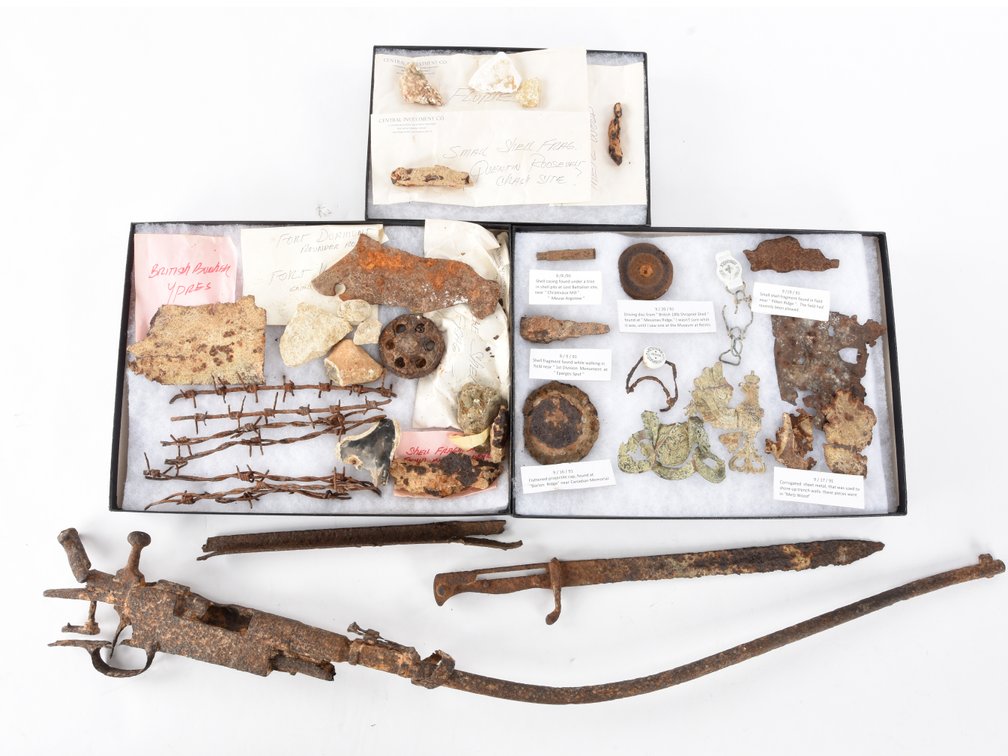
#310 • Western Front Battlefield Relic Lot Including Lebel Rifle
Part of Ghosts of the Great War: A No-Reserve Auction of WWI Militaria (live auction by Bannerman Auctions)
High bid $250.00
Status: SOLD
Category: Other
Western Front Battlefield Relic Lot Including Lebel Rifle Lot includes two 12" x 16" collector display frames and one 8.5" x 12" frame, filled with shell fragments, bits of corrugated sheet metal from trench walls, the base of a minenwerfer shell, recovered Bavarian and Prussian spike helmet wappen, barbed wire, etc., much (but not all) of it labeled as to where it was recovered. Also includes a battlefield relic Imperial German S.98/05 bayonet, and features a battlefield relic French Lebel rifle which has been dramatically twisted, likely by the effect of a shellburst. The force from artillery explosions can be much like a tornado, turning the once-formidable implements of war into mute testimonials to the effect of being downrange amid the sudden and violent arrival of high explosives. In this case, we can see that the bolt was open at the time that the shell arrived. It is interesting to think that as that last fired cartridge was being ejected, a shell landed that not only bent the barrel in multiple directions, but also the back end of the bolt! Though from a logical, practical perspective this rifle is clearly now lethal only to someone not up-to-date on their tetanus shots.. it is in the eyes of the law still a modern rifle, and must transfer via an FFL as a -nsn- (no serial number) post-1898 firearm. Those of us who are enthusiastic students of Great War history will always value artifacts that we have discovered on the sacred ground ourselves (where permitted). However, for many practical reasons above even the expense and time required for such a pilgrimage, finding relics such as these that have been carefully collected and preserved by one of our colleagues such as the collector who brought these home years ago, affords many of us an opportunity that we would not otherwise be able to manage. Relic hunting on the Western Front in France and Belgium remains quite common, fueled by the region's continuing "Iron Harvest"—the annual discovery of tons of unexploded World War I and II ordnance as farmers plow their fields. Collectors, hobbyists, and even local residents continue to uncover a remarkable array of relics, ranging from personal equipment and uniform fragments to intact ammunition. While this practice can be a source of valuable historical artifacts, it is fraught with dangers. Both battlefields and agricultural lands are littered with live shells, grenades, and chemical munitions, some of which are still capable of being accidentally detonated even a century after the war. Fatalities occur every year, and experienced diggers have died or been severely injured by explosions or exposure to toxic agents, such as residual mustard gas. The legal and practical hurdles faced by collectors seeking to export battlefield relics to the United States add another layer of difficulty. In France and Belgium, relic hunting on historic battlefields is strictly regulated; metal detectors are generally banned, unauthorized digging can lead to arrest and confiscation of equipment, and possession or export of relics (especially ordnance, weapons, or items classified as archaeological finds) is closely controlled by law enforcement. Even legally obtained artifacts can be challenging to bring back to the United States, as U.S. Customs enforces regulations on importing items like deactivated firearms, ammunition, and antiquities, often requiring certification that items are inert or safe. Collectors must navigate both European and American laws on historical property, hazardous materials, and cultural patrimony, with many shipments subject to inspection, delays, or seizure. As a result, sourcing Western Front relics for U.S. collections demands not only historical expertise, but also an understanding of international law and careful logistical planning. $400 - $600