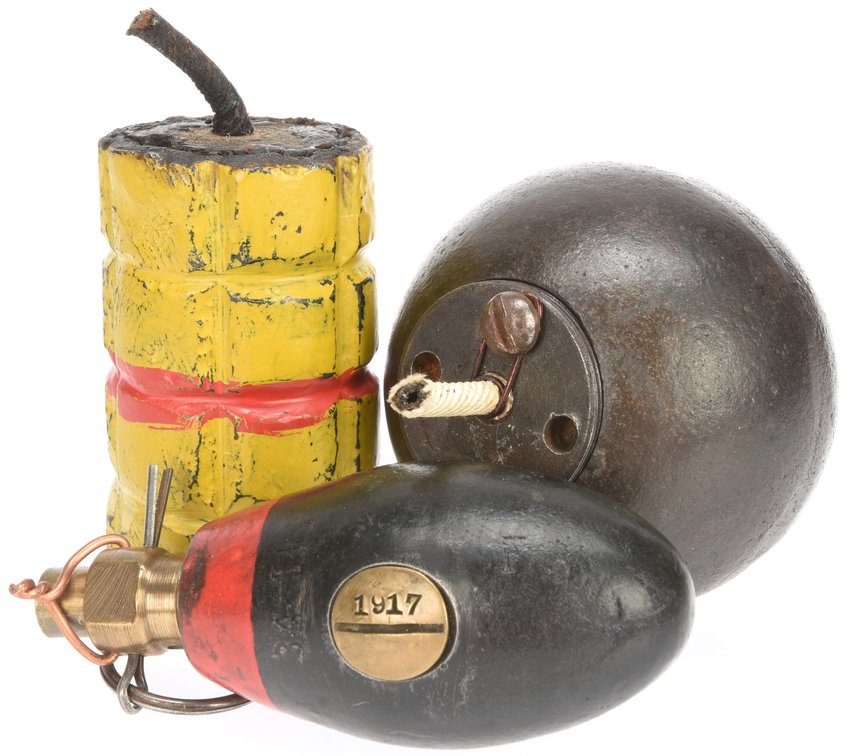
#228 • British WWI Inert Grenades: Battye Bomb, No. 15 'Cricket Ball' Grenade, & No. 34 'Testicle' Grenade
Part of Ghosts of the Great War: A No-Reserve Auction of WWI Militaria (live auction by Bannerman Auctions)
High bid $800.00
Status: SOLD
Category: Britain
British WWI Inert Grenades: Battye Bomb, No. 15 'Cricket Ball' Grenade, & No. 34 'Testicle' Grenade The Battye bomb was an interim weapon manufactured in the town of Bethune, France, in 1915 for the British Army, based on the design of Captain B.C. Battye of the Royal Engineers. These grenades consist of a segmented roughly cast iron cylinder sealed with a wooden plug, and fitted with variety of fuzes. This example has a simple wood plug and cloth fuze installed (supported by pasteboard on the interior, as the interior is happily empty). Exterior has yellow paint with a red stripe. No. 15 ball grenade or 'cricket ball' grenade is a 3" diameter iron sphere with a threaded plug and time fuze. Example has dark patina and a display analog installed to represent the fuze. This grenade - frequently called the “cricket ball” grenade by ANZAC troops - was a time-fused, cast iron anti-personnel grenade first introduced in 1915 during World War I. Developed to address the shortcomings of earlier designs like the No. 1 grenade, the No. 15 featured a spherical body with internal grooves for fragmentation and was filled with ammonal explosive. Troops lit the grenade by striking the matchhead igniter, with a five-second fuse for throwing and a nine-second fuse for catapult launching. Mass-produced in staggering numbers, it was used heavily in the Battle of Loos and in Middle Eastern campaigns, but damp trench conditions frequently rendered its fuse unreliable, resulting in a high rate of misfires. Its relatively large size and weight also made it awkward to throw, which, combined with insufficient fragmentation, led to its replacement by improved types such as the No. 16 oval grenade and ultimately the No. 5 “Mills bomb.” No. 34 Mk III 'testicle' grenade was introduced in 1917 to rival the lightweight German 'Eierhandgranate.' Body is in good condition but with a red stripe near the top and dark patina on the remainder. Has brass fuze assembly with a replacement pull ring safety, brass plug on the side. Markings include designation "No. 34 III", maker "FB" and date "1917" on the plug. We are sometimes squeezed, tickled, or teased to reveal our historical source for these as 'testicle' grenades. Just between us - I simply made that up on a lark a few years ago, and have been delighted to see it carried forward on it's own momentum as our catalog descriptions are shamelessly plagiarized by other websites and references. I'm sure we're not the first, though. The trenches were filled with munitions nicknamed for their appearance: toffee apples, eggs, lemons, pears, doves, turtles, and even flying pigs. Seriously - what else are you going to call this one? These are three rather nice examples of these particular British grenades. $200 - $300