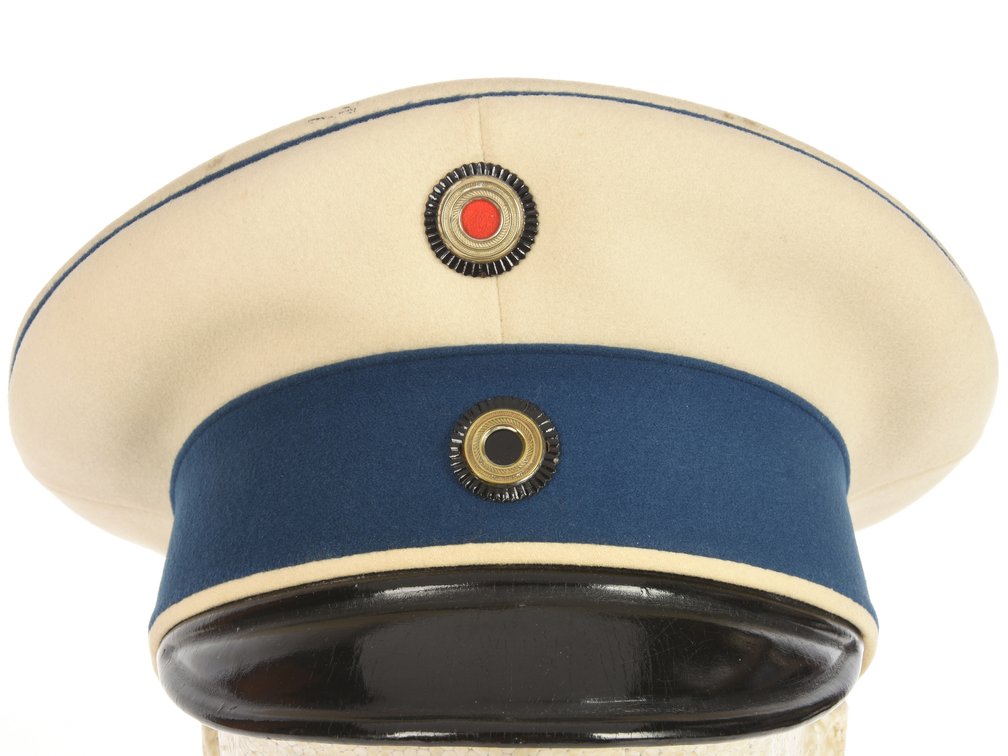
#61 • Imperial German Garde-Kürassier Regiment Officer's Visor Cap
Part of Ghosts of the Great War: A No-Reserve Auction of WWI Militaria (live auction by Bannerman Auctions)
High bid $1,600.00
Status: SOLD
Category: Imperial Germany
Imperial German Garde-Kürassier Regiment Officer's Visor Cap White wool schirmütze has blue wool band and piping, officer's Reich and Prussian cockades, and a black Vulkanfiber visor. Interior has light tan leather sweatband embossed with the owner's name, and a white silk crown lining with gilt embossed crown and "R" initial. Interior of the visor has a dark red finish. Cap remains in very good condition with a few minor stains and discolorations, no readily apparent mothing and no heavy wear. The Garde-Kürassier Regiment, established in 1815 and later reorganized as a cuirassier regiment in 1821, served as the premier heavy cavalry unit of the Royal Prussian and subsequently Imperial German Army. The regiment played a prominent role in many of the era's major conflicts including the Second Schleswig War, the Austro-Prussian War, the Franco-Prussian War, and World War I, embodying the shock and spectacle of traditional cavalry on the battlefield even as the modern age rendered such units increasingly ceremonial. The Garde-Kürassiers were renowned for their imposing uniforms, discipline, and their role as a visible symbol of the Prussian military tradition and elite formation within the Guards Cavalry Division. During World War I, the Garde-Kürassier Regiment began the conflict as traditional heavy cavalry, participating in the initial German advance through Luxembourg and Belgium into northern France and fighting in the early mobile battles, such as the Battle of the Marne and the subsequent retreat to the Aisne. However, as the war quickly transitioned to static trench warfare, the regiment’s traditional cavalry role became obsolete. They performed border guard duties on the Belgian-Dutch frontier before being transferred to the Eastern Front in 1915, where they took part in operations in Russian Poland and Galicia and engaged in both mounted and dismounted actions. By late 1916, reflecting the changing nature of combat, the Garde-Kürassiers were converted to Kavallerie-Schützen (cavalry rifle) troops, essentially serving as infantry within the Guards Cavalry Rifle Division. They saw service on various fronts, including positional fighting in the East and later on the Western Front, where they fought as dismounted infantry until the war’s end in November 1918. The regiment’s experience in World War I illustrates the decline of traditional cavalry tactics in the face of modern weaponry and trench warfare, marking the end of an era for the distinguished mounted regiments of Imperial Germany. In pre-war Imperial German culture, the Garde-Kürassier Regiment represented the enduring ideals of aristocratic privilege and martial valor in Imperial Germany. Service in the regiment was largely the preserve of the nobility and upper classes, with its spectacular white parade uniforms and eagle-topped helmets making the unit a fixture in official ceremonies and state occasions. Their public role and historical pedigree reinforced their status not only as elite warriors but as symbols of national pride and the social hierarchy that underpinned the German Empire. The regiment is significant as a testament to the intersection of military spectacle, tradition, and class prominence within the structure of Imperial German society. $600-$800